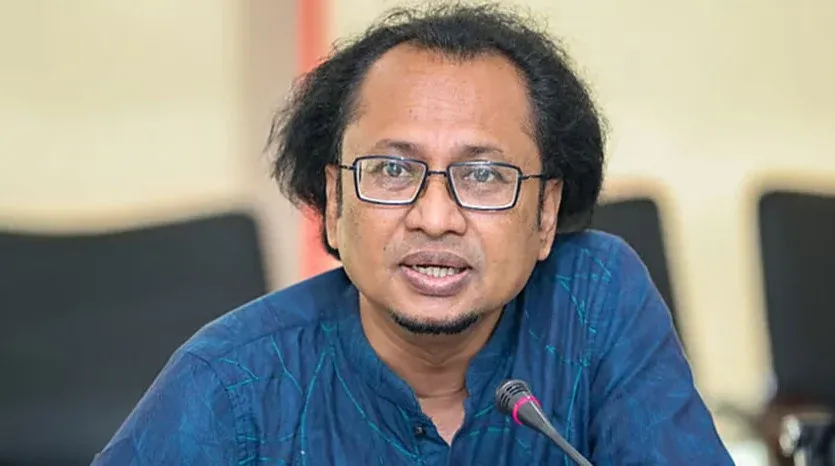
Prime Minister’s Information and Broadcasting Adviser Dr Zahed Ur Rahman has said the country’s institutions were severely damaged over the past one and a half decades during the previous Awami League government.
He made the remarks on Tuesday while participating in a panel discussion at a national conference on formulating a five-year strategic framework for achieving the Sustainable Development Goals (SDGs). The conference was held at the Bangladesh-China Friendship Conference Centre in Dhaka.
Zahed Ur Rahman said various forms of misinformation had been disseminated through manipulation over the years. Against this backdrop, he said, it would be unrealistic to expect major changes within only six months of the present government taking office.
The adviser also said it would be inappropriate to directly compare Bangladesh’s current situation with that of Sri Lanka.
He explained that Sri Lanka faced severe economic mismanagement under its government, eventually resulting in a reserve crisis. However, the country had an elected government and its institutions had not been dismantled, he said.
As a result, the new government in Sri Lanka found it comparatively easier to undertake economic reforms after assuming office, he added.
Zahed said an inflated picture had previously been presented regarding the size and growth of Bangladesh’s gross domestic product (GDP).
He said the country experienced a period of stagnation accompanied by inflation during the final three to four years of the previous Awami League government.
“I am not saying that our future is very bleak. But we probably need to keep in mind the foundation on which we are standing. We are still paying the price for the disastrous governance of the past 15 years,” he said.
“From a technical perspective, considering where we are now, it may seem that our economic reforms or growth should at least have been progressing faster. As far as I understand economics, I do not think the situation can be explained by any simple reason,” he added.
The adviser said it would not be easy to immediately change the mindset that had developed within the police and other state institutions over the past 15 years.
“Many people in the bureaucracy have also lost the understanding of how to work with an elected political government. An elected political government will seek quick results because it will want to show those results to the people and seek their votes again. Such tendencies were absent over the past 15 years,” he said.
“That is why I believe the issues of institutional reform are interconnected. We need to give some time for these reforms to be implemented,” he added.
Economist Professor Dr Wahiduddin Mahmud chaired the panel discussion.
Policy Exchange Bangladesh Chairman and Founder Dr M Masrur Reaz, retired Professor of Economics at the University of Dhaka Abu Ahmed, Secretary of the Statistics and Informatics Division Md Firoz Sarkar and Secretary of the Finance Division Dr Md Khairuzzaman Majumder also participated in the discussion.