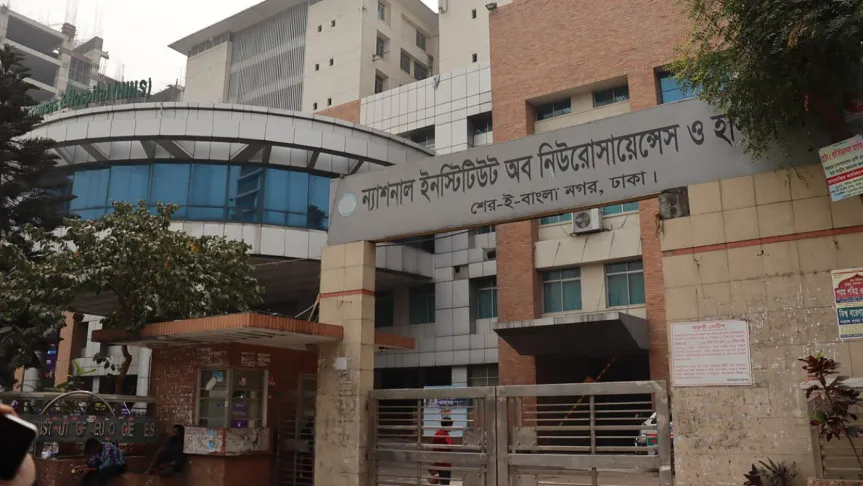
Healthcare services for neurological patients in Bangladesh are expanding significantly with the launch of a newly constructed 500-bed unit at the National Institute of Neurosciences and Hospital (NINS) in Agargaon, Dhaka. Prime Minister Tarique Rahman is expected to officially inaugurate the state-of-the-art facility at 10:00 AM on Saturday (August 15), marking a major milestone in specialized public health infrastructure.
According to hospital administration officials, structural construction and the installation of advanced medical equipment across the new 15-story complex are complete. With the addition of the new 500-bed extension, the hospital’s total capacity will expand to 1,000 beds, transforming NINS into the largest specialized neurological healthcare center in the country. The newly erected facility features three basement levels dedicated to organized vehicular parking and utility service operations, while the upper 12 floors house general wards, specialized operation theaters, and diagnostic units. The expanded complex includes 40 Intensive Care Unit (ICU) beds, 20 High Dependency Unit (HDU) beds, 24 post-operative care beds, 62 ventilators, and 112 private cabins.
Hospital physicians noted that stroke victims constitute the majority of incoming admissions, followed by trauma patients suffering from acute brain and spinal injuries sustained in road traffic accidents or falls. The institute also provides expert care for complex neurological conditions such as Parkinson's disease, dementia, Guillain-Barré Syndrome (GBS), epilepsy, and hydrocephalus across all age demographics.
The newly constructed "NINS Unit-2" stands out as the first public hospital facility in Bangladesh to feature a fully centralized air conditioning system. To cater to severe physical trauma patients, the facility includes a specialized 100-bed Trauma Unit backed by 24-hour dedicated emergency surgical services. Out of the four newly established operation theaters, two are state-of-the-art Modular OTs equipped with advanced German technology designed to maintain sterile, controlled surgical environments and minimize post-operative infection risks. Additionally, escalators connecting the first three floors have been installed to ease patient movement between levels—another first for a government healthcare institution in the country. Advanced diagnostic and operational infrastructure includes a Cath Lab, two MRI machines, two CT scanners, advanced autoclaving systems, a solid medical waste disposal network, and an independent central oxygen plant.
Speaking to the state news agency BSS, Director of the National Institute of Neurosciences and Hospital, Professor Dr. Mohammad Nuruzzaman Khan, expressed optimism regarding the expanded capacity: "Prime Minister Tarique Rahman will officially inaugurate the new building on Saturday, adding 500 crucial beds to our institute. Currently, due to severe bed constraints, we are often forced to turn away critical patients as admissions are restricted strictly to available beds. Following the inauguration, we will be able to deliver world-class specialized care without having to refuse patients."
Professor Dr. Nuruzzaman Khan further recalled the historical origin of the institution, noting that former Prime Minister, the late Begum Khaleda Zia, originally laid the foundation stone for the National Institute of Neurosciences on October 23, 2006, to elevate national neurological care. He added that the inauguration of the expanded facility by her son, Prime Minister Tarique Rahman, on her birthday stands as a deeply meaningful achievement and a moment of immense pride for the institute's medical community.