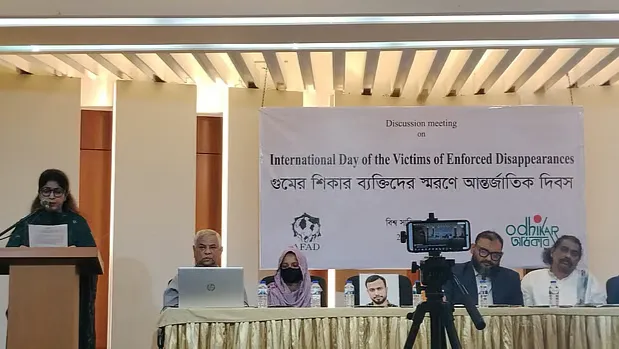
Families of victims of enforced disappearances gathered in the capital on Saturday ahead of the International Day of the Victims of Enforced Disappearances, voicing deep outrage over the newly proposed anti-disappearance bill and expressing grave concern over allegations of fresh disappearance incidents under the current administration.
Speaking at a seminar organized by human rights organization Odhikar at Bishwo Shahitto Kendro in Banglamotor, around 20 affected families and two survivors shared emotional testimonies demanding the safe return of their loved ones and calling for an independent investigative framework. Mukta Khatun, wife of missing fisherman Miraj Sheikh from Bagerhat, stated that her husband was forcibly picked up in plainclothes on April 10, 2026, by Coast Guard personnel and remains missing. Another relative, Anisha Islam Insha, noted that her father, Ismail Hossain Baten, disappeared in 2019, adding with anguish that reports of disappearances are regrettably persisting even after August 5.
Presenting a written position on behalf of Odhikar, Training and Advocacy Director Tasneem Farhana raised serious reservations regarding the revised "Enforced Disappearance Prevention and Redress Bill" placed before the Jatiya Sangsad on August 27. Pointing to Section 14(3) of the proposed legislation—which allows another discipline force or an inter-force body to investigate allegations brought against a member of a discipline force—Farhana argued that investigations conducted by security forces themselves risk inherent bias. She further cautioned that a provision mandating up to five years of rigorous imprisonment for complaints deemed false by courts would intimidate victims' families and widen impunity.
Odhikar placed a three-point demand before the government, urging the mandate to investigate enforced disappearances to be vested exclusively in an independent National Human Rights Commission, introducing legal mechanisms allowing families of the disappeared to manage bank accounts and property, and withdrawing fabricated cases against returned victims. Lawmaker Mir Ahmad Bin Quasem, himself a former victim of enforced disappearance, criticized the draft bill as fundamentally flawed, asserting that tasking one security agency to probe another undermines impartiality. Supreme Court Bar Association President Mahbub Uddin Khokon MP also addressed the gathering, urging lawmakers to craft an inclusive and universally protective legal framework.