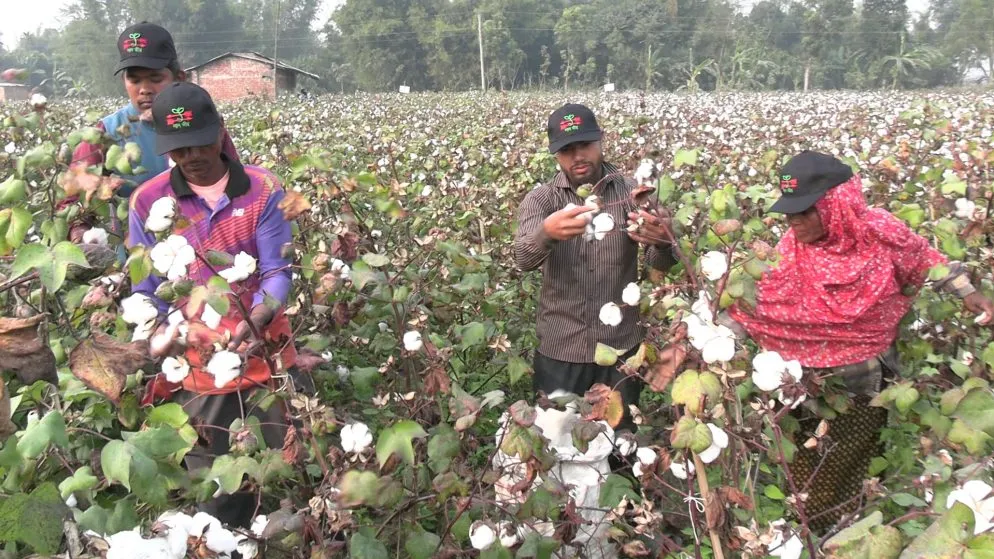
Farmers in Thakurgaon are earning good returns from cultivating the hybrid DM-4 variety of cotton.
The initiative, supported by government agencies and private seed suppliers, has encouraged increased cotton cultivation in the district.
Data from the Thakurgaon Cotton Development Board shows cotton cultivation in the district has grown from 426 hectares in 2021–22 to 564 hectares in 2025–26, with an average yield of nearly 4 tons per hectare.
Local farmers, including Nuruzzaman, Moniruzzaman, Saruj Ali, Ehsan Ali and Yakub Ali, said, “Cultivating hybrid DM-4 cotton on one bigha costs Tk25,000–30,000. The yield is 18–20 maunds. With the current market price at around Tk4,000 per maund, one bigha of cotton sells for Tk70,000–75,000, giving a profit of about Tk30,000–35,000.”
Farmers said the good returns with relatively low effort have encouraged them to expand cotton cultivation in the next season. They also called for guaranteed fair prices and adequate supply of fertiliser and pesticides.
According to officials of the Thakurgaon Cotton Development Board, in the 2021–22 fiscal year, cotton was cultivated on 426 hectares combining local and hybrid varieties, producing 2,816 bales. In 2023–24, the target was 452 hectares, but 491 hectares were actually cultivated. By 2025–26, cultivation rose to 564 hectares, with an average yield of nearly 4 tonnes per hectare.
In the Thakurgaon zone, which includes Panchagarh, Dinajpur, and Thakurgaon districts, the target was 1,400 hectares, and 1,379 hectares were cultivated. The zone has around 4,000 cotton farmers, and 300 farmers received incentives this season.Mehedi Hasan Khan, Rangpur regional officer of the seed supplier Lal Tir Seed Ltd, said, “Farmers are receiving technical support through the supply of high-quality seeds and regular field visits. Good yields and quality have made the DM-4 variety increasingly popular in there region.”
He added that efforts are underway to encourage farmers to expand cotton cultivation alongside other crops.
Selina Akhtar, chief cotton development officer of the Thakurgaon zone, said the ease and profitability of cultivation are increasing farmers’ interest. With incentives, training, and overall support, the Cotton Development Board is working to produce at least 15–20% of the country’s total cotton demand domestically in the coming years.