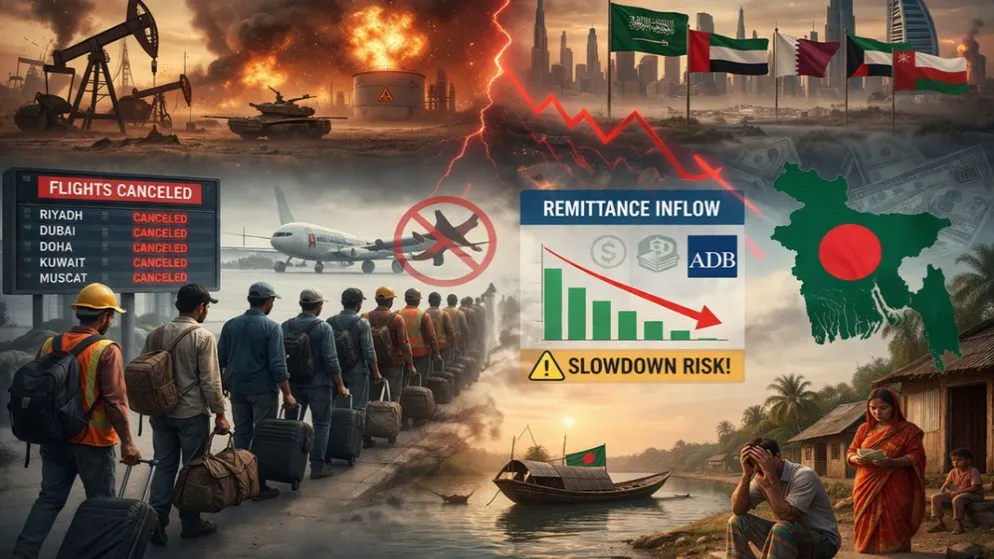
The ongoing conflict in the Middle East has created fresh concerns for Bangladesh’s economy. For a country heavily dependent on expatriate income, the conflict raises fears of a slowdown in remittance inflows. This warning was highlighted in a recent report by the Asian Development Bank.
The report states that if the conflict in the Middle East persists, demand in the labor market may decline, leading to reduced income for migrant workers. This would directly impact remittance inflows. Countries in South Asia, including Bangladesh, are considered most vulnerable in this regard, as a significant portion of their workforce is employed in the Middle East.
The issue is particularly critical for Bangladesh. Of the country’s annual $30 billion in remittances, nearly half comes from the Middle East. Bangladeshi workers in countries such as Saudi Arabia, United Arab Emirates, Qatar, Oman, and Kuwait are the main contributors to this income. Therefore, any instability in the region could directly put pressure on Bangladesh’s foreign currency inflows.
The impact of the conflict is already becoming visible. Due to recent tensions, a large number of flights to the Middle East have been canceled, disrupting the deployment of new workers and the movement of existing ones. This has created uncertainty in the overseas labor market.
According to the ADB analysis, if the conflict continues, economic growth in developing Asia could decline by up to 1.3 percentage points during 2026–27. At the same time, instability in the energy market could push inflation up by more than 3 percent.
Experts note that remittances are not only a source of foreign currency but also a key driver of the rural economy. Money sent by expatriates supports millions of families and fuels local demand. A decline in remittances could therefore reduce domestic consumption.
Meanwhile, the possibility of rising fuel prices is creating additional pressure. As Bangladesh relies heavily on imported fuel, any increase in global prices directly raises production and transportation costs, which could further drive up inflation.
However, the ADB believes that if the crisis remains temporary, the situation may gradually stabilize. If energy markets become stable, inflation could begin to ease by 2027.
Overall, the Middle East conflict is not just an international issue for Bangladesh—it could have deep economic implications. A slowdown in remittance inflows may pose serious challenges to foreign exchange reserves, import costs, and overall economic stability.