Business leaders have called for a harassment-free and investment-friendly environment to help generate employment, reduce public hardship, and restore economic momentum.
They believe that such an environment would accelerate economic development and boost revenue collection. According to them, national budgets are often designed in a punitive manner and should instead be made supportive.
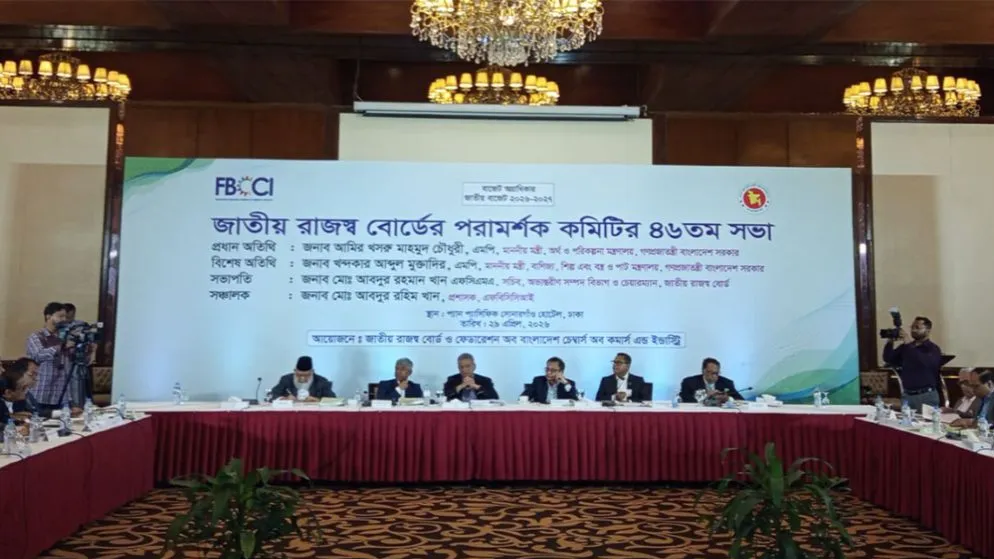
They also highlighted the current challenges facing trade and commerce and demanded reforms in the country’s revenue system, along with simplification of tax policies. These issues were raised at the 46th meeting of the advisory committee jointly organised by the National Board of Revenue (NBR) and the Federation of Bangladesh Chambers of Commerce and Industry (FBCCI), held at a luxury hotel in the capital on Wednesday.
The meeting was chaired by NBR Chairman Md. Abdur Rahman Khan, while Finance Minister Amir Khasru Mahmud Chowdhury attended as the chief guest. He assured business leaders that the government would do as much as possible regarding duties and taxes.
He said that although all demands may not be fully met, laws and regulations would be made more business-friendly to ease doing business.
Earlier in the meeting, FBCCI proposed raising the tax-free income threshold for individual taxpayers to Tk 500,000, up from the current Tk 375,000. It also recommended reducing corporate tax rates.
For non-listed companies, FBCCI proposed lowering the tax rate from 27.5 percent to 25 percent, reducing turnover tax from 1 percent to 0.50 percent, and cutting the 1 percent source tax imposed on export-oriented sectors, including the readymade garment industry, to 0.50 percent, with the reduced rate to remain in place for five years. The session was moderated by FBCCI Administrator Abdur Rahim Khan.
Representatives from various sectors presented their demands during the meeting.
Senior Vice President of the Bangladesh Real Estate and Housing Association (REHAB), Abdur Razzaq, said that ensuring simple, modern, and harassment-free services for taxpayers would not only increase revenue collection but also create an investment-friendly environment. He emphasized that a fair and just tax system plays a crucial role in strengthening the foundation of national development.
President of the Metropolitan Chamber of Commerce and Industry (MCCI), Kamran T Rahman, stressed the need for a budget that generates employment, revitalizes the economy, and alleviates public suffering. He proposed introducing a unified taxpayer profile integrating income tax, banking, and customs, along with a one-page digital tax return system. Such initiatives, he noted, would increase the number of taxpayers, reduce tax evasion, and help build a transparent and robust tax culture in the long term. He also complained that mandatory provisions and high penalties are hindering the business environment.
Secretary General of the Bangladesh Restaurant Owners Association, Imran Hossain, alleged that bureaucratic complexities have effectively turned everyone into “systematic offenders.” He claimed that enforcement actions are often taken against compliant taxpayers, while non-compliant ones go unchecked.
President of the Bangladesh Aluminium Manufacturers Association, Obaidur Rahman, warned that industries are shutting down and urged authorities to save them. He suggested increasing direct taxes and deploying tax officers at district and sub-district levels to enhance income tax collection.
President of the Bangladesh Reconditioned Vehicles Importers and Dealers Association (Barvida), Abdul Haque, said that the country’s automobile market has shrunk significantly—from around 30,000 vehicles annually to below 10,000 last year. Registrations by the Bangladesh Road Transport Authority (BRTA) have also dropped to one-third. He attributed this decline to rising dollar prices and currency depreciation, which have made vehicles unaffordable for the middle class. Reducing high import duties on vehicles, he said, would help revive the market.
FBCCI further proposed setting a 2 percent VAT rate at the local level for all goods supplied by small and medium enterprises. It also recommended imposing a maximum 1 percent import duty on machinery, spare parts, and raw materials not produced domestically, and a maximum 3 percent duty on those produced locally, to protect domestic industries.
In his concluding remarks, NBR Chairman Md. Abdur Rahman Khan said that the country’s economy would progress if businesses move forward. He assured that business concerns would be carefully considered in the upcoming budget, with efforts to make tax and duty measures as supportive as possible. He also noted that the NBR is working to simplify revenue compliance processes and emphasized the need to expand the tax net to reduce inequality, a goal that has broad national consensus.