The National Economic Council (NEC) on Monday approved the Annual Development Programme (ADP) for fiscal year 2026-27 with an outlay of nearly Tk300,000 crore, describing it as a roadmap for economic reforms, balanced growth and long-term development.
The approval came at an NEC meeting held at the Planning Commission auditorium in Agargaon, Dhaka, with NEC Chairperson and Prime Minister Tarique Rahman in the chair.
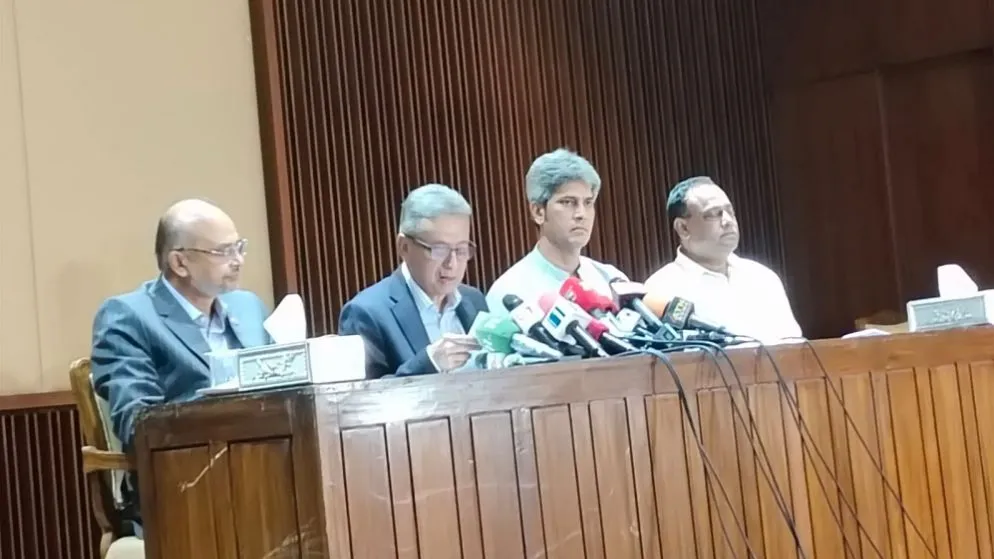
Briefing reporters after the meeting, Finance and Planning Minister Amir Khosru Mahmud Chowdhury said the proposed ADP reflects the priorities outlined in the government’s election manifesto and marks the first full-fledged development programme under the elected government.
“This is a very important meeting. After a long time, an elected government is going to present a full budget. The development plan reflects our commitment to rebuilding the economy and moving towards sustainable growth,” he said.
According to the minister, the proposed ADP size has been set at around Tk300,000 crore, including Tk190,000 crore from government funds and Tk110,000 crore from project loans and grants.
He said the new ADP is not limited to infrastructure expansion alone, but also focuses on state reforms, reducing inequality, strengthening macroeconomic stability and ensuring balanced regional development.
The minister said the programme has been designed under a “Five-Year Strategic Framework for Reform and Development” and organised around five key pillars.
Amir Khosru said restoring financial discipline and maintaining macroeconomic stability are now among the government’s top priorities.
“In recent years, excessive borrowing from local banks at high interest rates not only increased the government’s financial burden but also crowded out the private sector. We want to move away from that model,” he said.
He added that avoiding excessive money printing and reducing dependence on high-interest bank borrowing remain major policy priorities for the government.
The finance minister also said the government is working to “democratise the economy” by ensuring wider public participation in economic activities.
“If people cannot participate in the economy and benefit from growth, democracy itself cannot be sustained,” he said, mentioning initiatives such as family cards, universal healthcare, farmer support and assistance for rural artisans.
Highlighting plans for economic deregulation, Amir Khosru said Bangladesh has become an “over-regulated economy” and unnecessary rules and bureaucratic barriers would be reduced to make business operations easier.
He said future budgets would place greater emphasis on deregulation and structural economic reforms aimed at encouraging investment and creating employment opportunities.
The minister also indicated higher allocations for the health and education sectors, saying there is no alternative to investing in human capital if Bangladesh wants to fully utilise its demographic dividend.
“We are focusing on vocational education and skill development across the country so that our workforce can access better jobs both at home and abroad,” he added.
Regarding project implementation, the minister said the government has introduced stricter criteria for appointing project directors and warned that newly approved projects must be completed within the stipulated timeframe.