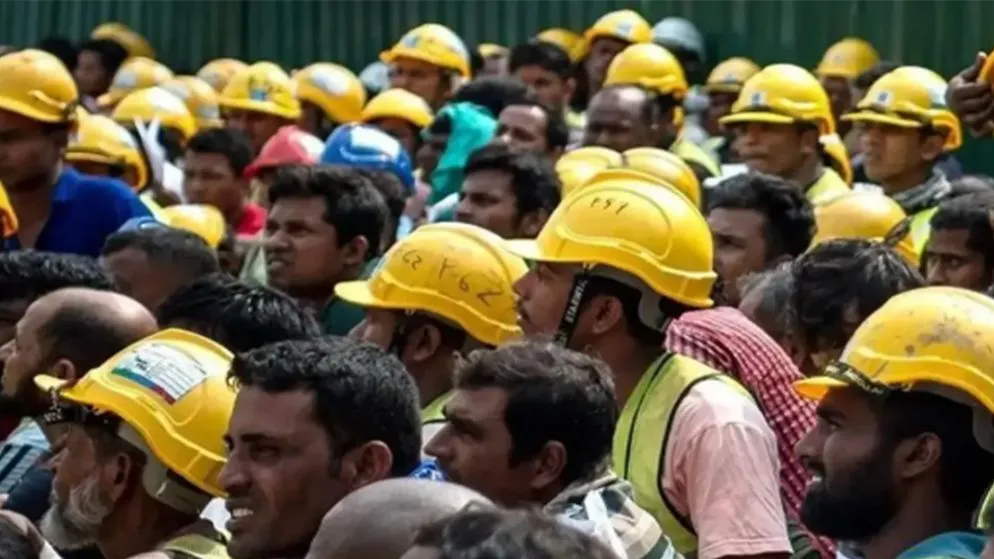
The COVID-19 pandemic dealt the biggest setback to the deployment of Bangladeshi workers to the Middle East labour market. Although overseas employment gradually began to recover afterward, the recent United States–Israel–Iran conflict spread its impact across the Middle East.
As a result, the recruitment of Bangladeshi workers by Middle Eastern countries has once again suffered a major setback, placing the sector under renewed pressure. At the same time, many migrant workers lost their jobs because of the conflict and were forced to return home. This has created fresh challenges for Bangladesh’s overseas labor market and foreign currency earnings.
According to sources, since the conflict began in the Middle East on 28 February this year, demand for new workers in countries such as Saudi Arabia, Kuwait, and Qatar has declined sharply.
Data from the Bureau of Manpower, Employment and Training (BMET) show that 153,636 Bangladeshi workers went abroad for employment between March and May this year. During the same period last year, the figure stood at 260,438. This means the number of outbound workers has fallen by approximately 41 percent within a year.
Labor market analysts say that due to the conflict, many companies in the Middle East’s infrastructure, tourism, service, and trade sectors have become cautious about hiring new employees.
Consequently, approvals for recruiting new workers have declined. In addition, the cancellation of hundreds of flights to the Middle East because of the conflict has delayed the departure of newly recruited workers. Airfares that previously ranged between Tk 50,000 and Tk 55,000 have now risen to between Tk 90,000 and over Tk 100,000 because of the flight shortage.
BMET statistics indicate that Bangladesh’s labor market remains heavily dependent on the Middle East. Saudi Arabia, Qatar, Kuwait, the United Arab Emirates, and Oman are the country’s major labor destinations.
Among them, Saudi Arabia receives the highest number of Bangladeshi workers. In 2025, around 752,000 of the total overseas workers from Bangladesh went to Saudi Arabia alone. In addition, 169,000 workers went to Qatar and 42,496 to Kuwait.
Meanwhile, from 1 January to 5 June this year, 314,362 Bangladeshi workers went abroad. Of them, 190,072 went to Saudi Arabia, 23,780 to Qatar, 8,753 to Kuwait, 7,353 to Jordan, 7,121 to the United Arab Emirates, and 3,091 to Iraq. These figures highlight the current trend of Bangladeshi migration to the Middle East.
In the post-pandemic period, a total of 1,126,368 Bangladeshi workers secured overseas employment in 2022. Saudi Arabia was the largest destination, receiving 391,302 workers. Oman received 163,021 workers, the United Arab Emirates 77,476, Kuwait 29,009, and Qatar 27,663.
Bangladesh sent a record number of workers abroad in 2023. Official figures show that 1,305,453 workers migrated overseas. Of them, 497,674 went to Saudi Arabia, 127,883 to Oman, 98,422 to the United Arab Emirates, 56,148 to Qatar, 36,548 to Kuwait, and 8,626 to Jordan.
In 2024, a total of 1,010,908 workers went abroad. Among them, 627,812 went to Saudi Arabia, 74,464 to Qatar, 47,158 to the United Arab Emirates, 33,015 to Kuwait, 15,410 to Jordan, and 4,230 to Lebanon.
Shariful Haque, a Bangladeshi expatriate living in the United Arab Emirates, told that he operates a restaurant in Dubai. The business had been doing well, but the Middle East conflict has directly affected the UAE. Following Iranian attacks, his restaurant had to remain closed for an extended period. Although the situation has somewhat stabilized, tourist numbers remain low. As a result, sales have not recovered despite reopening. His income has fallen significantly, making it difficult to run the restaurant or send money to his family in Bangladesh.
Asked about the current situation of Bangladeshi workers migrating to the Middle East, Mazharul Bhuiyan, Secretary of the Association of Travel Agents of Bangladesh (ATAB), told that the Saudi Arabia route is now close to being shut down.
He said that working there has become highly risky due to the conflict. Most visas currently being issued for Kuwait are old ones, while new visa issuance has nearly stopped. Just as people were beginning to recover from the pandemic, the Middle East conflict erupted. Flight cancellations and constantly changing schedules have further complicated travel. At the same time, airfares have surged from Tk 50,000–55,000 to more than Tk 90,000–100,000.
Regarding tourist visas, he said that travel visas for Oman and Dubai have remained suspended for a long time. In Saudi Arabia, apart from Umrah visas, most other visa categories are experiencing stagnation. Companies are reluctant to recruit new workers amid ongoing uncertainty. Rising fuel costs have also pushed up airfare prices, dealing a severe blow to travel agencies and the broader travel trade.
Migration expert Asif Munir told that Bangladesh’s labor market has long been centered on the Middle East, with Saudi Arabia being the primary destination. However, there has been insufficient structural effort to systematically diversify labor markets, reduce risks, or develop alternative destinations. Although policy discussions continue, most labor migration still depends on private agencies and personal networks.
As a result, when major crises occur, Bangladesh suffers directly because alternative markets are not adequately prepared. He warned that the current conflict is increasing concerns about job security and regular wage payments for Bangladeshi workers in the Middle East, which could negatively affect remittance inflows in the long run. He emphasized the need for stronger bilateral agreements and technology-based training to address these challenges.
Shariful Islam, Head of the BRAC Migration Programme, said that the time has come to rethink Bangladesh’s dependence on low-skilled labor migration and remittances. Despite sending around 2 to 2.5 million workers to Saudi Arabia over the past five years, remittance earnings from the country have declined to between $3.5 billion and $4 billion.
He argued that excessive migration costs have resulted in large-scale capital outflows and exploitation. He also noted severe agricultural labor shortages in migrant-dominated districts such as Tangail, Cumilla, and Munshiganj, increasing production costs. Meanwhile, many people from districts such as Madaripur spend huge sums traveling through Libya to reach Italy by sea, only to become destitute, while their home districts remain economically underdeveloped.
He added that the government should shift its focus from counting how many workers are sent abroad to assessing how skilled they are and how much remittance they generate. Bangladesh has a demographic dividend window of approximately 20 to 25 years before the population begins to age.
Therefore, he stressed the need to make technical and vocational education compulsory through coordination between the education and expatriate welfare ministries. He also suggested taking diplomatic initiatives to send workers to new reconstruction markets, including war-affected countries such as Iran, as alternatives to the Middle East.
Because of the ongoing conflict, a number of Bangladeshi workers have already returned from Iran and Bahrain. So far this year, 201 Bangladeshis have returned from Iran with government assistance, while 282 workers have returned from Bahrain.