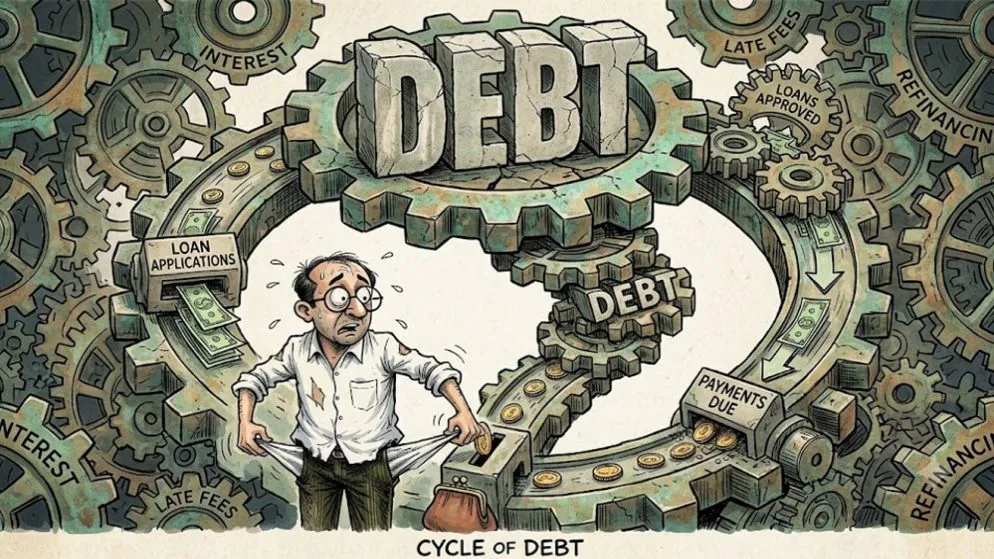
A large section of Bangladesh's low- and middle-income population is increasingly falling into a debt trap due to the relentless rise in living costs, limited incomes and a lack of savings.
When a family member suddenly falls ill, or when expenses arise for children's education, marriage or other emergencies, many are forced to sell land, borrow money at high interest rates, or depend on loans from NGOs and banks.
For numerous families, even meeting basic needs has become a struggle, leaving them burdened with debt and financial insecurity. Some, unable to bear the pressure, have even resorted to suicide out of despair.
Conversations with people in Dhaka and various districts reveal that families that were once able to save modest amounts are now struggling to cover daily necessities with their monthly incomes. Prices of rice, lentils, cooking oil, vegetables, fish, meat and other essential commodities have risen sharply. At the same time, housing rents, healthcare costs and education expenses have increased significantly.
While living costs have soared, incomes have failed to keep pace. As a result, ordinary people are finding it increasingly difficult to balance limited earnings against ever-growing expenses. Saving money has become a distant dream, with many families struggling simply to meet their minimum needs.
Abdul Karim, a farmer from Tarash in Sirajganj, said, "After my wife fell ill two years ago, I had to borrow money for her treatment. Later, I sold land to repay the debt. Now I am being forced to take out another loan to cover my son's educational expenses."
Rubina Akter, a garment worker in Gazipur, shared a similar experience. "Although my salary has increased slightly, market expenses have risen much more. Whenever an emergency arises, I have to borrow from relatives or NGOs. To repay one loan, I end up taking another."
Altaf Hossain, an employee of a private company in Dhaka's Dholairpar area, said, "My salary barely lasts until the 20th of the month. House rent, my children's school fees and grocery expenses consume everything. Forget savings—I have to borrow something from acquaintances almost every month."
Economists say a large portion of lower- and middle-income households are becoming trapped in debt for various reasons. Many are being forced to break emergency savings accounts or terminate deposit schemes to cope with rising expenses.
Dr. Mustafa K. Mujeri, former Director General of the Bangladesh Institute of Development Studies and former Chief Economist of Bangladesh Bank, told Bangladesh Pratidin that rising living costs are quietly pushing many families into debt.
"The greatest pressure is being felt in three areas—healthcare, higher education for children and essential daily expenses—particularly among middle- and lower-middle-income families," he said.
He stressed the need for effective policies to control the costs of healthcare, education and essential goods, as well as the expansion of social safety-net programmes. He also emphasized the importance of financial planning, reducing unnecessary spending and fostering a culture of savings.
Healthcare expenses have become one of the biggest financial burdens for families. Many are forced to spend hundreds of thousands of taka at private clinics due to the unavailability of beds in public hospitals or rising medicine prices. Recent research indicates that a significant portion of the population falls below the poverty line each year due to healthcare costs alone.
Many families are borrowing from local moneylenders at exorbitant interest rates to finance medical treatment, only to find themselves unable to repay the debt later.
Rafiqul Islam, a garment worker, said with emotion, "I needed Tk 100,000 for my wife's uterine surgery. Since I had no savings, I had to borrow from a village moneylender at a high interest rate. Now the monthly interest payments consume nearly half of my salary."
In Bangladeshi society, weddings and other major social events are increasingly becoming sources of financial distress rather than celebration. For many families, arranging a marriage means taking on a heavy debt burden. Social pressure and concerns about maintaining status often lead people to spend beyond their means.
To cope with these costs, many families are selling their last remaining assets, including farmland and homesteads. In rural areas, the sale of land at extremely low prices to finance a daughter's wedding or overcome a family crisis has become increasingly common.
Once these assets are lost, many families lose their primary source of income, pushing them into deeper poverty. Economic analysts warn that if this trend continues, crime, social instability and mental health problems could increase further.
The pressure of mounting debt is already driving some people toward tragic outcomes, including suicide. From cities to villages, the picture remains largely the same: a growing number of families struggling to escape an ever-tightening cycle of debt.