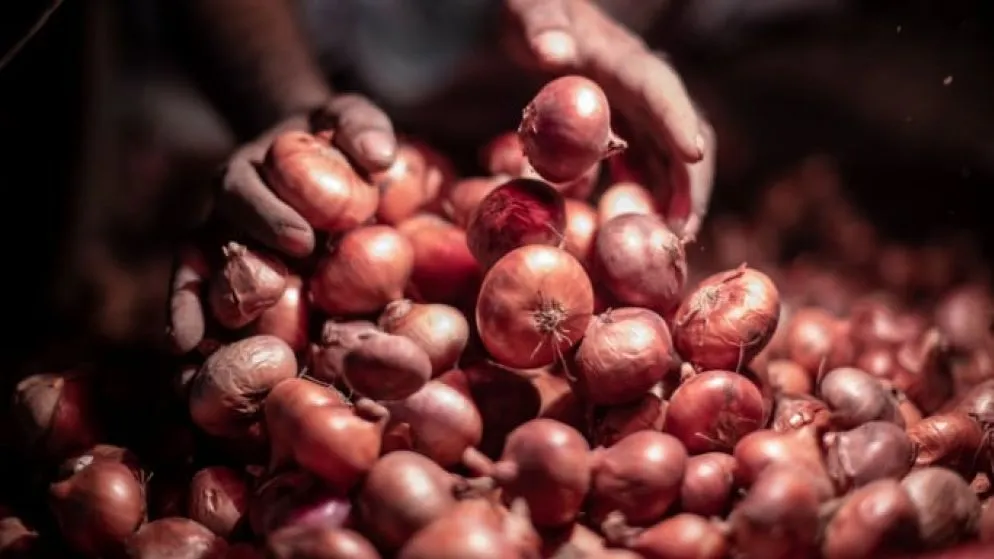
A bumper onion harvest has turned into financial setback for farmers across Bangladesh’s leading onion-producing districts in the southwest and north. Instead of reaping the expected profits, the growers are facing mounting losses after prices of the product plunged within weeks, leaving many unable to recover even their production costs.
Market observation shows that farmers are losing around Tk 500 per maund on average. While many are forced to loss-making sales, one farmer dumped sacks of onions into a river in protest over the lack of fair prices, an incident that has since gone viral on social media.
According to farmers and agricultural officials, favourable weather and the expanded cultivation of hybrid onion varieties resulted in a bumper harvest this season across the country’s principal onion-growing districts. These include Kushtia, Jhenaidah, Magura, Faridpur, Rajbari, Rajshahi and Pabna, along with other important producing districts --Natore and Meherpur.
Officials at the Department of Agricultural Marketing and the Department of Agricultural Extension said that these major producing districts account for nearly half of Bangladesh’s total onion production every year. During the current season, onions were cultivated on approximately 188,000 hectares of land in these districts, yielding around 19 lakh tonnes.
Bangladesh's annual onion demand stands at approximately 35 to 36 lakh tonnes, while national production this year reached about 32 lakh tonnes, officials said.
Pabna remains the country's largest onion-producing district, cultivating onions on 45,665 hectares and producing nearly 750,000 tonnes this season. Faridpur ranks second, with cultivation on nearly 42,000 hectares and production of around 600,000 tonnes.
Officials say farmers are now bringing their stored onions to market because the upcoming rice planting season requires cash for cultivation expenses.
According to the Department of Agricultural Marketing, the seven major onion-producing districts have 285 model onion storage facilities, each capable of storing 250 to 300 maunds of onions. Together, these facilities currently hold around 10,000 tonnes of onions.
A visit to markets in Kushtia and adjacent Rajbari found that during the harvesting season in March, onions were selling for more than Tk 1,000 per maund, depending on quality. However, prices have since plunged to below Tk 800 per maund.
At Sonapur, the largest onion wholesale market in Rajbari's Baliakandi upazila, onions are currently selling for only Tk 600 to Tk 800 per maund. Farmers say it costs them approximately Tk 800 to Tk 1200 per maund to produce, harvest, transport, and market their onions, including expenditures on irrigation, fertilizers, pesticides, labour and transportation. As a result, many are incurring losses of around Tk 500 per maund.
Rajbari district alone cultivated onions on 30,478 hectares this year.
At Sonapur market, this correspondent met farmer Palash Mia, whose video recently went viral on social media. The footage shows him standing on a bridge and throwing sacks of onions into the river below.
“When we harvested the onions, they were selling for Tk 1,000 to Tk 1,100 per maund," he said. “Now we are forced to sell them for only Tk 600 to Tk 700. At these prices, we cannot even recover our production costs.”
He explained that because the onions he brought to market were off slightly lower grade, traders refused to offer a reasonable price. Out of frustration, he threw nearly four maunds of onions, packed in three sacks, into the river.
Farmer Alamgir Hossain Bhyian said the cost of fertilizers, diesel, and agricultural labor has increased significantly this year.
"It cost between Tk 30,000 and Tk 35,000 to cultivate onions on a bigha of land. The current market price doesn't even cover our production costs," said Alamgir Hossain Bhyian.
Another farmer, Ruhul Quddus Saleh, said storing onions has become another financial burden.
“We have to keep electric fans running continuously to prevent the onions from rotting and our electricity bills have nearly doubled,” he said. "If the government does not intervene to ensure fair prices, many farmers will reduce onion cultivation next year.”
Dr. Shahidul Islam, Deputy Director of the Rajbari Department of Agricultural Extension, said prices have declined because of a sharp increase in market supply.
Officials also noted that the lack of adequate cold storage and modern warehousing facilities prevents farmers from storing this highly perishable crop for extended periods. Consequently, many are forced to sell immediately, even at low prices, to avoid spoilage.
According to field observation, rainfall during the harvesting period made the situation even wose. Farmers said higher moisture levels reduced the crop's shelf life, forcing many to dispose of their harvest quickly before it spoiled.
Experts say the annual cycle of price crashes is driven by weak production planning, inadequate storage infrastructure, and an inefficient marketing system.
Majedul Haque, Associate Professor of Marketing at Islamic University, Kushtia, said that when farmers fail to receive fair prices at harvest, they suffer substantial losses.
In the following season, many reduce cultivation, creating supply shortages and causing prices to spike again.
He emphasized that breaking this cycle will require expanding storage infrastructure, increasing direct government procurement from farmers and strengthening market oversight.
Besides, the agricultural officials remain hopeful that market conditions will gradually stabilize in the coming weeks.