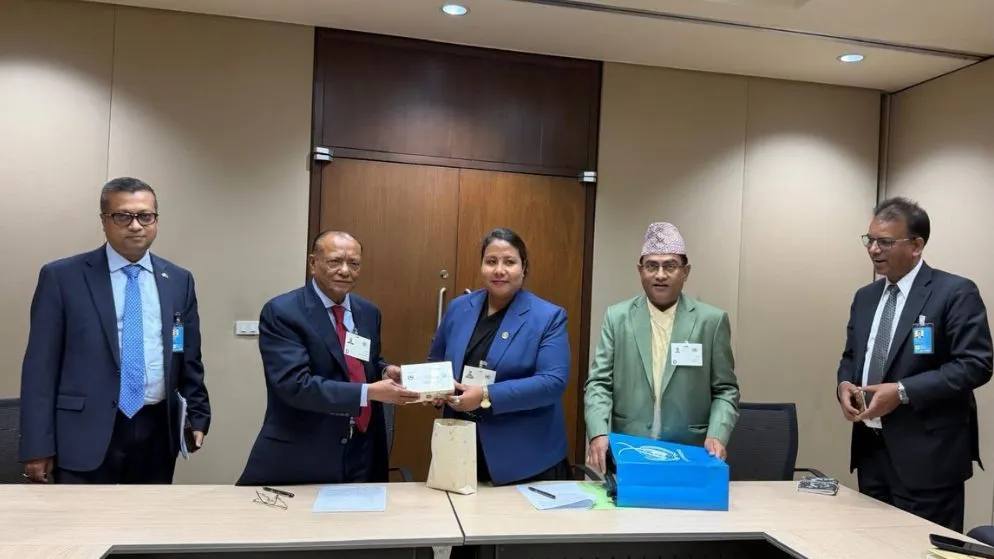
Environment, Forest and Climate Change Minister Abdul Awal Mintoo had a productive first day at the Ninth Session of the Committee on Environment and Development (CED9) of UNESCAP in Bangkok on Thursday.
The minister participated in the opening session and the ministerial roundtable, where he highlighted Bangladesh's commitment to advancing a sustainable bioeconomy as a pathway to climate resilience, green jobs, food security, and inclusive development, according to the Embassy of Bangladesh in Bangkok.
He also shared Bangladesh's experiences in promoting green jute products, rural bioenergy, mangrove conservation and climate-friendly innovation, while emphasising the importance of regional cooperation, knowledge sharing, technology transfer, and sustainable financing.
On the sidelines of CED9, the minister held a fruitful bilateral meeting with Gita Chaudhary, minister of agriculture, forest and environment of Nepal.
The two sides reaffirmed the long-standing friendship between Bangladesh and Nepal and discussed expanding cooperation in climate action, sustainable bioeconomy, agriculture, renewable energy, and sustainable development, including opportunities in organic farming, seed production, agricultural value chains, herbal medicine, and hydropower.
Mintoo also inaugurated the side event titled “Realizing Synergies in Asia and the Pacific through a Sustainable Bioeconomy,” jointly organised by the Embassy of Bangladesh in Bangkok in collaboration with UNESCAP, the Food and Agriculture Organization of the United Nations (FAO), and the Asian Disaster Preparedness Center (ADPC).
In his opening remarks, he highlighted the importance of the bioeconomy as a catalyst for sustainable growth, environmental protection, and regional partnerships.
The event brought together policymakers and experts to explore how a sustainable bioeconomy can support climate action, biodiversity conservation, circular solutions, and inclusive economic growth through stronger regional cooperation and partnerships.
The minister also participated in the plenary discussions, reaffirming Bangladesh's commitment to advancing climate action and sustainable development at both the regional and global levels.