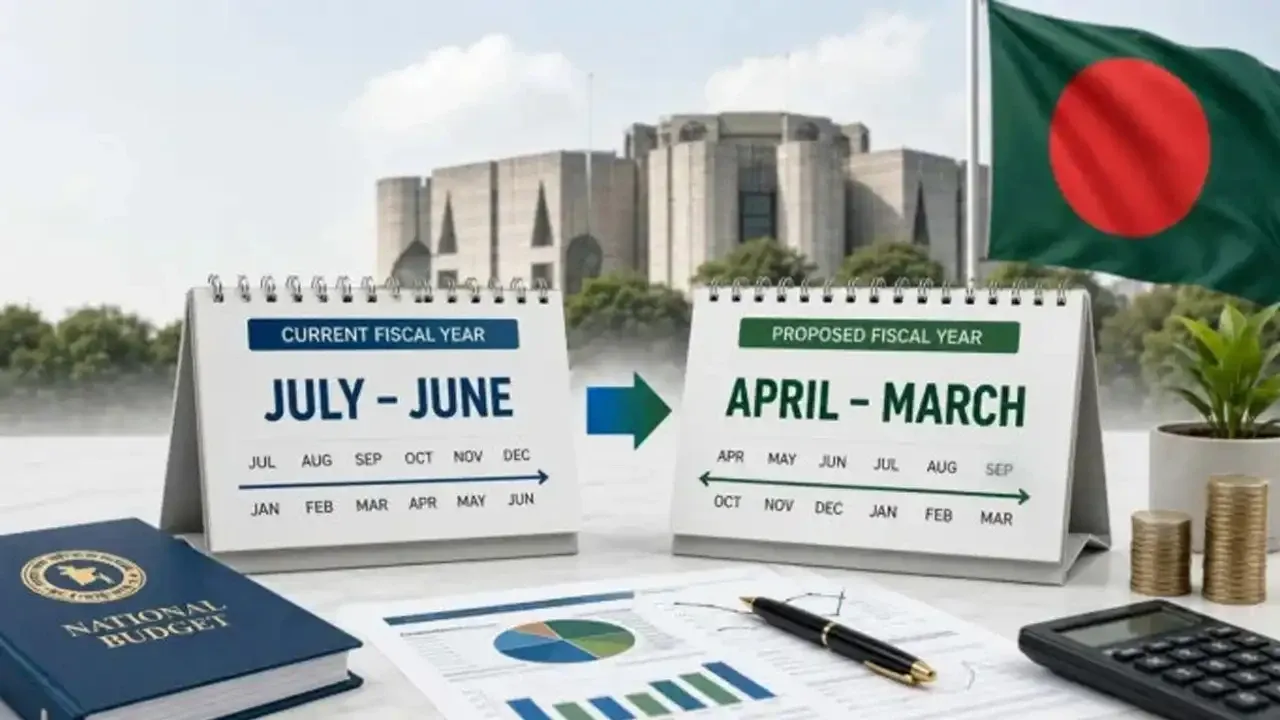
In a major restructuring of the country’s macroeconomic planning, the government has decided to alter Bangladesh’s fiscal year timeline for the first time in nearly 55 years. Starting from the 2028–29 fiscal year, the financial calendar will transition from the existing July–June cycle to an April–March cycle, officially commencing on April 1 and concluding on March 31.
To facilitate a seamless structural transition, the 2027–28 fiscal year will serve as an interim transition period. That financial year will span a nine-month duration from July 2027 to March 2028, paving the way for the full launch of the April–March framework on April 1, 2028.
Monsoon Challenges and Infrastructure Drive
The core rationale behind this strategic recalibration lies in climate considerations and the execution of development projects. Under the current July–June calendar, the final quarter—April, May, and June—coincides with early monsoons and intense rainfall, routinely halting major infrastructure work on roads, bridges, and water resource projects.
Shifting the final quarter to January, February, and March aligns project completion with the country's driest season. Authorities anticipate this will eliminate the customary end-of-year rush in June, minimize low-quality hasty execution, and streamline annual budget expenditures.
Colonial Legacy and International Realignment
The July–June framework dates back to British colonial administration and continued through the Pakistan era. Following independence, Bangladesh’s first Finance Minister, Tajuddin Ahmad, presented a transitional budget spanning December 16, 1971, to June 30, 1972, after which the July–June system became standard. While the existing setup matches the World Bank’s reporting calendar, sovereign nations retain full autonomy to set fiscal years that best suit their climatic, agricultural, and domestic realities.
Systemic Overhaul and Expert Perspectives
The timeline change requires extensive technical realignment across state financial architecture. Software platforms and reporting schedules under the National Board of Revenue (NBR), Bangladesh Bank, and the Finance Division must be restructured, alongside adjustments to tax assessment years, VAT cycles, corporate audits, public procurement, and fund release mechanisms.
Economic analysts note that while the shift will support infrastructure timelines, deeper institutional reforms remain essential. Khondaker Golam Moazzem, Research Director at the Centre for Policy Dialogue (CPD), highlighted that structural issues in social sectors like health and education are unrelated to rainfall and require governance overhauls. Professor Md. Ahsan Habib of the Bangladesh Institute of Bank Management (BIBM) noted that lasting improvements in Annual Development Programme (ADP) delivery will depend on addressing fund management and project governance alongside calendar realignments.
A high-level joint committee comprising the Cabinet Division, Bangladesh Bank, NBR, Legislative Division, and Finance Division has been designated to oversee technical readiness for the upcoming shift.