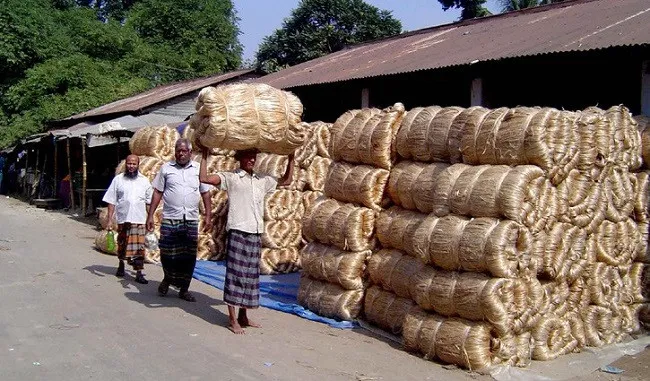
Rajshahi district is experiencing an exceptionally plenteous yield of the golden fibre this season, potentially generating a massive local market turnover of approximately Tk 549 crore, as highly favorable weather conditions, expanded cultivation areas, and lucrative market prices bring renewed smiles to regional farmers.
The Department of Agricultural Extension (DAE) projects that the district will yield approximately 49,000 tonnes of high-quality jute this season. With the current market price fluctuating between Tk 4,000 and Tk 4,300 per maund, agricultural economists estimate that the total commercial transaction could reach around Tk 548.82 crore. This substantial influx of capital is expected to inject fresh dynamism into the rural economy by enhancing farmers' disposable incomes and consequently boosting the demand for consumer goods and essential services in local markets.
Demonstrating a renewed agricultural focus, jute has been extensively cultivated across all nine upazilas of the district this season. Official data indicates that a total of 18,399 hectares of arable land has been brought under jute cultivation, reflecting a significant increase compared to the 17,305 hectares utilized last year. The agriculture department had initially set a production target of 49,000 tonnes for the current season, an upward revision from the 48,677 tonnes successfully produced during the previous harvest.
According to the latest comprehensive field assessment by the DAE, harvesting and traditional fibre extraction processes have already been completed on approximately 82 percent of the total cultivated land, resulting in the production of nearly 48,200 tonnes of raw jute so far. Agricultural officials remain highly optimistic, projecting that total production will comfortably exceed the initial target once the remaining 18 percent of the standing crop is fully processed. Field-level reports confirm that ideal weather conditions from the very onset of the season, supplemented by adequate monsoon rainfall and farmers' intensive crop care, played a pivotal role in securing this higher yield. The timely rainfall particularly assisted farmers in the arduous tasks of retting and washing the raw jute, substantially minimizing the operational difficulties conventionally associated with fibre processing.
The prevailing market dynamics have further galvanized the enthusiasm of local growers. High-grade raw jute is currently trading at Tk 4,000 to Tk 4,300 per maund in local wholesale markets, while premium quality bundles have remarkably fetched prices as high as Tk 4,500 to Tk 5,000 in certain commercial hubs. Elaborating on the factors driving this agricultural success, Mita Sarkar, Additional Deputy Director (Crops) of the Rajshahi District Department of Agricultural Extension, stated:
"Both the total area under cultivation and the overall production volume increased significantly this year, largely driven by timely government agricultural incentives and the uninterrupted supply of improved-quality seeds and essential fertilisers to the grassroots level."
She affirmed that the district's rural economy is poised to witness aggregate jute transactions worth approximately Tk 549 crore, calculated at a conservative average of Tk 4,300 per maund. Meanwhile, Assistant Director of the Department of Jute in Rajshahi, Nadim Akhtar, provided further statistical context, noting that approximately 3,81,696 quintals of processed jute are expected to be produced across the district this year, marking a robust increase of about 21,000 quintals over last year's total output.
Grassroots jute farmers are openly expressing profound satisfaction over the current market profitability. Shafiqul Islam, a seasoned jute cultivator from the Monigram area of Bagha upazila, recalled that farmers had faced severe disappointment last year due to depressed market prices. Reflecting on the current turnaround, Shafiqul noted that this year, both the per-acre yield and the market price have been exceptionally good. "As I can comfortably sell my raw jute for more than Tk 4,000 per maund, I am expecting a very handsome profit margin after fully covering all my production costs," he added confidently.
Similarly, Abdul Matin, a progressive farmer operating in Mohanpur upazila, credited the adequate and timely rainfall for making the traditionally labor-intensive processes of retting and washing much easier and cost-effective this season. "With the current strong market price holding steady, I sincerely hope to save some substantial capital after meeting all my family and living expenses," Matin shared. In Paba upazila, farmer Rabiul Islam reported that he was already securing a highly lucrative return by strategically cultivating an early-maturing variety of jute on four bighas of land. Nevertheless, despite the positive outlook, Rabiul pointed out that escalating agricultural labor costs and occasional localized shortages of adequate water facilities for proper retting remain major operational challenges facing rural farmers.
Sharing similar sentiments, farmers Saidur Rahman of Bagmara and Hridoy of Charghat expressed strong optimism, suggesting that if these favorable market prices continue consistently, it will inevitably encourage many more local farmers to significantly expand their jute cultivation acreage next year.
Crucially, the premium jute produced across Rajshahi is not limited merely to fulfilling regional demands. After adequately supplying local wholesale markets, a massive portion of the raw fibre is systematically transported to major jute-product manufacturing conglomerates located in different industrial zones across the country. Furthermore, with the steadily expanding international market demand for diversified and eco-friendly processed jute products, a significant volume of the high-grade fibre collected directly from Rajshahi is being channeled for export, directly contributing to the nation's vital foreign-exchange reserves.
Analyzing the broader macroeconomic impact of this agricultural boom, Dr. Rafiqul Islam, a former professor of Economics at Rajshahi University, observed that the simultaneous increase in jute production and the securing of better market prices are sending an exceptionally positive signal for the stability of the rural economy. He asserted that the estimated influx of Tk 549 crore in direct jute-related transactions will exponentially increase the purchasing power of farmers, thereby driving up the demand for diverse goods and services in local markets and effectively stimulating comprehensive economic activity across rural areas. Providing a crucial policy recommendation to sustain this growth, Dr. Rafiqul Islam emphasized, "However, to ensure that the hardworking farmers receive the full financial benefit of their labor, it is absolutely imperative to reduce the exploitative influence of middlemen and systematically expand direct marketing channels alongside robust, government-supported storage facilities."