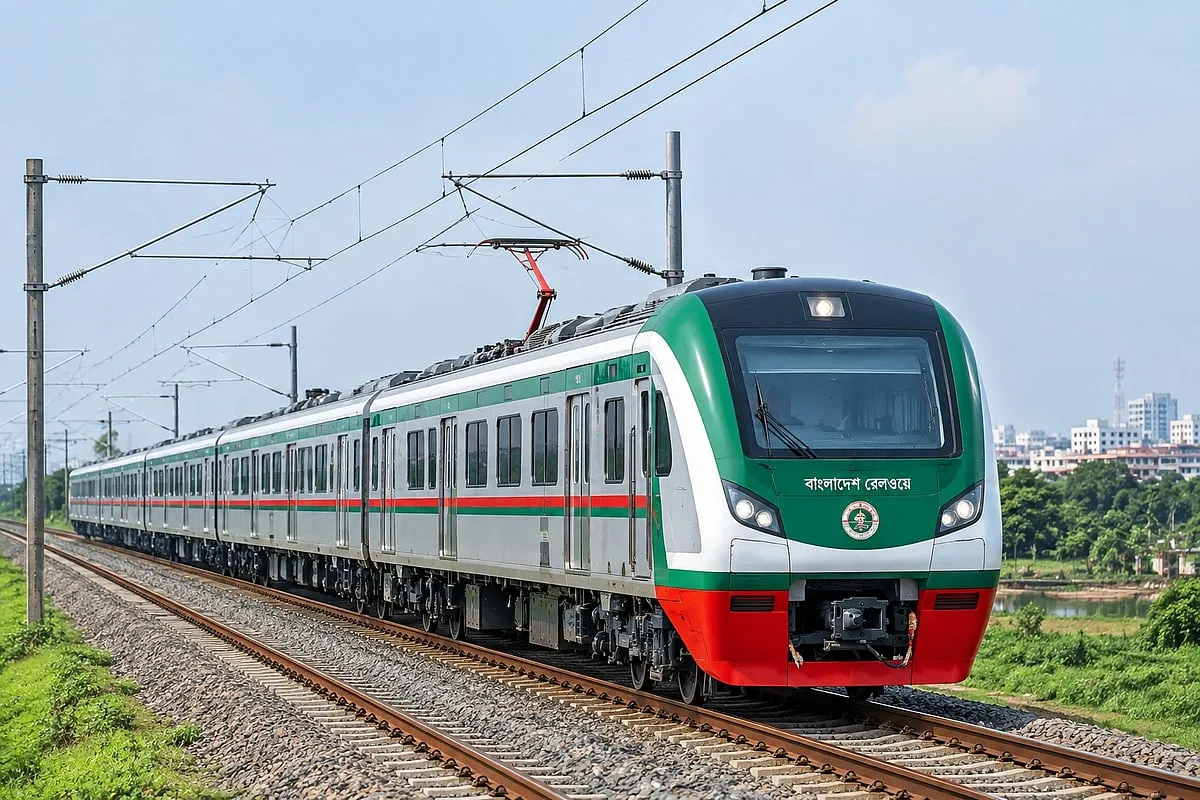
The government has undertaken a landmark initiative to operate trains on electricity rather than diesel, aiming to build an eco-friendly and modern mass transport network. As part of this drive, a mega project to introduce electric traction or an overhead catenary system along the 52-kilometre Narayanganj–Dhaka–Joydebpur railway corridor is being placed before the Executive Committee of the National Economic Council (ECNEC) for formal approval. The Asian Development Bank (ADB) and the European Investment Bank (EIB) are providing external financing for the Tk 3,822 crore venture.
According to Planning Commission sources, the proposed project, titled "Introduction of Electric Traction on Narayanganj–Dhaka–Joydebpur Section," entails the construction of overhead catenary infrastructure across a 52.32-kilometre railway alignment. Under the specific framework, a total of 16 sets of five-coach Electric Multiple Units (EMU), or electric passenger trains, will be procured. Furthermore, a modern EMU repair and maintenance depot will be set up at the Joydebpur end to handle regular rolling-stock servicing. The targeted completion deadline has been scheduled for June 2031.
The venture was initially drafted with an estimated budget of Tk 4,282.86 crore. However, a review by the Project Evaluation Committee (PEC) in April rationalized expenditures across multiple operational heads, trimming the total cost by Tk 460.35 crore—or roughly 12 percent—to settle at Tk 3,822.51 crore. Of this outlay, Tk 942 crore will be financed directly from the state exchequer, while the remaining Tk 2,880 crore will be secured through project loans from the ADB and EIB.
Sector stakeholders noted that shifting to electric traction will cut fuel consumption expenses by roughly 40 percent and slash operational maintenance overheads by 35 to 40 percent compared to conventional diesel-electric locomotives. Benefiting from higher operational acceleration, the average operating velocity along this alignment will rise by 18 to 20 percent, permitting trainsets to clock sustained cruising speeds of 80 to 100 kilometres per hour. Consequently, intercity commuting times will shorten significantly. In addition to easing highway traffic congestion across the bustling industrial belts buffering the capital, the transition will significantly curtail carbon footprints and air pollution.
Noting that Bangladesh lags significantly behind global benchmarks in electric railway deployment, transport infrastructure expert and BUET Professor Md Hadiuzzaman pointed out that while 70 percent of trains in India and 95 percent in China run on electricity, Bangladesh faces a lengthy structural transition that must begin immediately. However, he cautioned that success hinges on uninterrupted electricity supply alongside specialized training for a technically proficient maintenance workforce. Drawing lessons from the operational underperformance of DEMU trainsets due to inadequate staffing and repair infrastructure, he urged heightened institutional vigilance for the project.
Officials at the Ministry of Planning stated that if this pilot project proves successful, the administration intends to expand electrified rail corridors across the major Dhaka–Chattogram route in phases. Highlighting the policy direction, State Minister for Planning Zonayed Abdur Rahim Saki stated that the railway sub-sector is receiving top government priority under an integrated transportation framework, with a fresh suite of developmental schemes in the pipeline to augment overall railway logistical capacity.