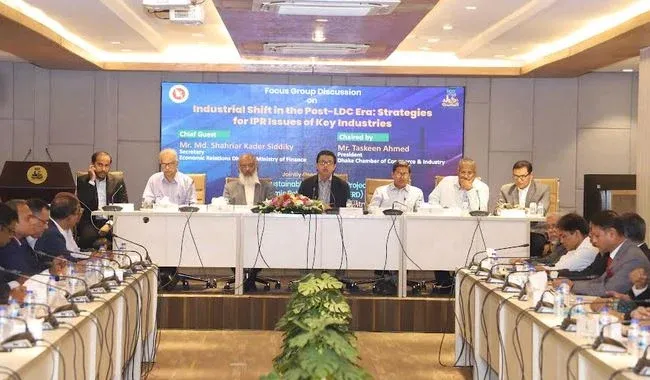
Bangladesh faces steep challenges regarding Intellectual Property Rights (IPR) enforcement following its graduation from Least Developed Country (LDC) status, as emerging international compliance across pharmaceuticals, IT, agriculture, and manufacturing risks inflating business costs and consumer prices. To navigate this shift, business leaders have urged the government to implement robust legal enforcement, sound policies, and modern institutional frameworks.
The recommendations were voiced on Monday at a focus group discussion titled "Industrial Transformation in the Post-LDC Era: Intellectual Property Rights Challenges and Strategies," organized in Motijheel by the Dhaka Chamber of Commerce and Industry (DCCI) in partnership with the Economic Relations Division’s (ERD) Support to Sustainable Graduation Project (SSGP). ERD Secretary Md. Shahriar Kader Siddiky attended as the chief guest, with DCCI President Taskeen Ahmed presiding over the session.
Speakers observed that while intellectual property legislation exists in Bangladesh, systemic procedural delays, institutional fragmentation, constrained enforcement capacity, and limited private-sector awareness persist. Delivering the keynote, Mohammad Ataul Karim, law faculty member at the University of Oxford and former WIPO Academy consultant, warned that post-LDC TRIPS and potential TRIPS-Plus provisions will terminate existing generic patent exemptions, potentially driving local retail prices of newly patented medicines two to five times higher than generic alternatives.
To fortify IPR infrastructure, DCCI President Taskeen Ahmed presented key proposals: establishing a modern, unified IPR office, instituting dedicated IP Tribunals in Dhaka and Chattogram to fast-track dispute resolutions, launching automated digital systems for trademark registrations, deploying specialized personnel, and raising awareness among SME entrepreneurs.
Addressing the forum, ERD Secretary Shahriar Kader Siddiky noted that international counterparts expect a time-bound roadmap rather than open-ended transition extensions. He outlined a strategic three-year transition plan: completing domestic preparations, regulatory compliance, and legislative reforms within the initial 24 months, followed by a six-month window dedicated to systemic market adaptation.
Contributing to the panel, Department of Patents, Industrial Designs and Trademarks (DPDT) Director General Md. Jahangir Hossain stressed aligning domestic frameworks with global commercial norms to safeguard export access. Bangladesh Copyright Office Registrar S.M. Arshad Imam called for enhanced digital forensic capacities to combat digital piracy, unauthorized streaming, and illegal content reproduction. BGMEA Secretary General Major General (Retd.) Md. Shahedul Islam highlighted the trade body's newly established Center of Excellence for apparel designs and urged incentives for innovators, while Incepta Pharmaceuticals DGM Faez Ahmed warned that unmitigated pharmaceutical patent enforcement could severely burden domestic public health. Agro-Chemical Manufacturers Association President Kazi Mostafizur Rahman and Brain Station 23 CEO Raisul Kabir underscored the necessity of prioritizing domestic high-tech innovation, agrochemical policies, and brand creation over pure outsourcing.