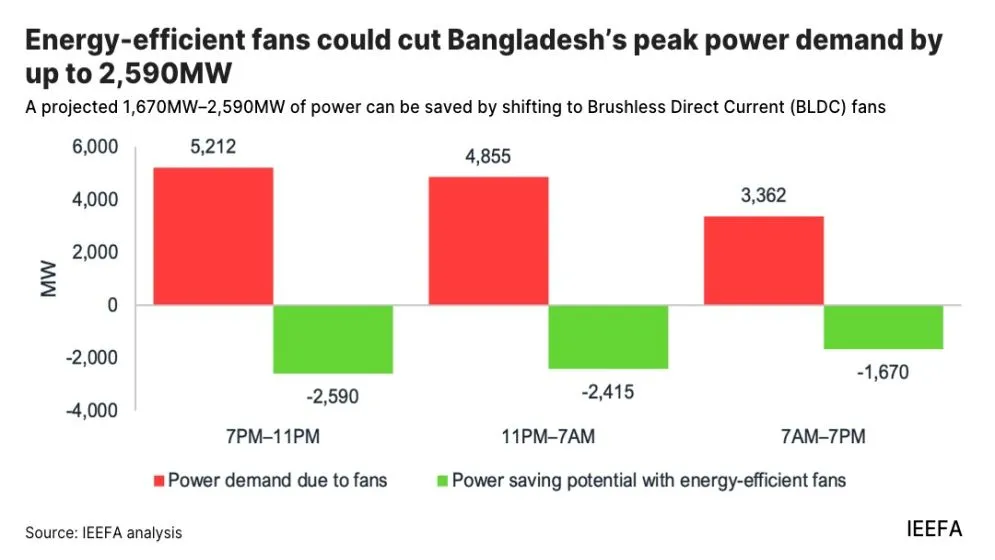
Bangladesh could cut its summer peak electricity demand by up to 2,590 megawatts (MW) and save Tk8,987 crore annually by replacing conventional household fans with energy-efficient brushless direct current (BLDC) models, according to a new study by the Institute for Energy Economics and Financial Analysis (IEEFA).
The shift could also help the country avoid more than $4 billion in investment in new coal-fired power plants, the study estimates.
The findings come as the country's power sector struggles with rising demand, fuel shortages and disruptions to electricity generation. Despite having an installed generation capacity of more than 29,000MW, Bangladesh continues to face supply shortages during periods of peak demand, largely because much of its generation capacity depends on the availability of gas, coal and liquid fuel.
The pressure was particularly evident in October, when fuel shortages forced dozens of power plants to remain offline and load-shedding reached 2,500MW, according to power sector officials. The situation highlighted how installed capacity alone does not guarantee an adequate electricity supply when demand is high.
Against this backdrop, IEEFA's latest report suggests that improving the efficiency of household appliances could provide a relatively quick way to ease pressure on the national grid, particularly during evening peak hours.
Titled Household Space Cooling in Bangladesh: Role of Energy-efficient Fans, the report estimates that household fans account for up to 5,212MW of summer electricity demand, with consumption peaking at around 9pm. Yet BLDC fans account for just 1.4% of the fans currently used in households.
“Global energy supply disruptions have compounded challenges, making it harder for the Bangladesh Power Development Board (BPDB) to meet power demand. Wider adoption of energy-efficient fans will reduce demand and ease the pressure on BPDB,” said Shafiqul Alam, IEEFA's lead energy analyst for Bangladesh and author of the report.
The potential savings are substantial. Bangladesh recorded its highest-ever peak electricity demand of 19,027MW at 9pm on August 27 this year, while the maximum reported power shortfall in August reached 3,757MW. The country's installed generation capacity stood at 29,143MW.
Based on a survey of 435 households across 26 districts and different income groups, IEEFA estimates that replacing inefficient fans with BLDC models could cut peak electricity demand by between 1,670MW and 2,590MW, depending on the time of day.
The transition could also save 6,913 gigawatt-hours (GWh) of electricity annually, equivalent to Tk8,987 crore or around $730 million at the rates used in the study. The reduction in peak demand could help Bangladesh avoid more than $4 billion in future capital investment in coal-fired power plants, it estimates.
“The use of BLDC fans would save up to 6,913 gigawatt-hours (GWh) of electricity a year, worth BDT89.87 billion (USD0.73 billion),” Alam said.
The findings point to an alternative to relying solely on new power plants to meet growing demand. Cutting electricity consumption in households could reduce the amount of power utilities need to generate, particularly during hours when the grid faces the greatest pressure.
Industry representatives say BLDC technology is gradually gaining ground, but high upfront costs and limited consumer awareness remain major obstacles to wider adoption.
Md Mahabubul Wahid, director of sales and marketing at BRB Cables Industries Ltd, said BLDC fans could reduce electricity consumption by around 50% compared with conventional models.
“Normal fans consume around 80 watts, while BLDC fans consume approximately 35 watts. This can save around 50% of the electricity used by a fan,” he told the Daily Sun.
Wahid said BRB had recently introduced BLDC fans and was still at an early stage of expanding its market. However, he expects the technology to become dominant in the coming years.
“By 2030, almost all fans in Bangladesh could be BLDC models,” he said.
He said energy-efficient fans could be particularly beneficial in Bangladesh's hot and humid climate, where many households cannot afford air conditioners. Greater dependence on air conditioning would put additional pressure on electricity supplies, while BLDC fans could provide cooling at a much lower energy cost.
Md Mahmudul Hasan, senior brand manager at Walton, described the shift towards BLDC technology as a major transformation for the fan industry, comparable to the transition from traditional incandescent bulbs to energy-efficient LED lighting.
He said conventional ceiling fans generally consume between 70 and 110 watts, while Walton's BLDC models use around 35 watts. A household running a fan for approximately 16 hours a day could save Tk2,800 to Tk3,000 annually by switching to a BLDC model, according to his estimate. Actual savings would depend on usage patterns and electricity tariffs.
Hasan said Walton had expanded BLDC technology across its fan range and manufactured the motors at its own facilities. Over the past two years, the company had also supplied more than 100,000 BLDC fans to around 200 to 250 factories.
Kamruzzaman Kamal, director (marketing) of PRAN-RFL Group, told the Daily Sun that the company introduced Click BLDC ceiling fans in 2024 and now offers seven models priced between Tk5,500 and Tk11,500.
He said the fans could save up to 65% of electricity, with selected models consuming around 35 watts while maintaining strong air delivery. The company manufactures both the motors and circuit boards in-house, allowing it to maintain control over product quality and performance.
“Since fans are among the most frequently used electrical appliances in households, switching to BLDC technology can make a noticeable difference in monthly electricity bills. Although the initial purchase cost is higher, regular savings on electricity can make the investment economical in the long run,” he said.
Kamal said Click planned to expand its energy-efficient fan range by introducing BLDC table, wall and stand fans. The company also aims to make the technology more affordable and accessible through competitive pricing and its nationwide distribution network.
Despite the growing availability of these products, their higher purchase price remains a major hurdle for households. According to IEEFA, a conventional fan costs around Tk2,000, while a BLDC model sells for between Tk5,000 and Tk6,300.
The price gap is particularly challenging for low-income families. The study estimates that around 40% of households earn up to Tk25,000 a month, with their average summer electricity bill standing at Tk663.
Although switching to an efficient fan could reduce their electricity bills over time, the initial cost remains difficult to manage. Without financial assistance, IEEFA estimates that households in this income group would need between 7.7 and 9.6 years to recover the additional cost, depending on daily usage.
Lack of awareness is another major obstacle. Around 75% of the surveyed households were unaware that BLDC fans were available in the market. However, after learning about their potential to reduce electricity bills, 96% said they were willing to switch to the technology.
That willingness does not necessarily mean consumers can afford the upfront cost. The survey found that 64% of respondents were willing to pay from their own funds, while 12% preferred instalment payments and 24% said they needed government support.
To address these barriers, IEEFA has proposed a nationwide programme combining bulk procurement, targeted financial assistance and public awareness campaigns.
Bulk purchasing could reduce the upfront cost of BLDC fans by around 25%, according to the study. It also suggests using potential revenue from carbon credits generated through lower electricity consumption to subsidise purchases by low-income households.
The report estimates that replacing inefficient fans could prevent more than 86 million tonnes of carbon dioxide emissions over 20 years, potentially generating $259.88 million in carbon revenue under its assumptions.
This revenue could help finance a Tk600 subsidy for each of more than 50 million fans, the study suggests.
Combining bulk procurement with carbon revenue could reduce the payback period for households earning up to Tk25,000 a month to around 4.8 years, based on the study's assumptions. The actual period would depend on daily fan usage and the availability of the projected savings and carbon revenue.
To oversee the nationwide transition, IEEFA has proposed establishing a government-backed super Energy Service Company (ESCO) to coordinate implementation, arrange financing, manage procurement and monitor performance.
The report also recommends that the Sustainable and Renewable Energy Development Authority (SREDA) finalise energy-efficiency standards and labelling for fans. Clear labels would allow consumers to identify efficient products and compare their electricity consumption before making purchases.
Another proposal is to introduce on-bill financing, allowing households to repay the cost of new fans in instalments through their electricity bills.
IEEFA has also called for a strong quality-control and monitoring system to ensure that fans sold under the programme deliver the promised energy savings.
“As Bangladesh's energy sector challenges mount, the country must prioritise measures that can provide quick relief by curbing demand growth. Energy-efficient fans are one such measure, cutting demand as soon as they are installed,” Alam said.