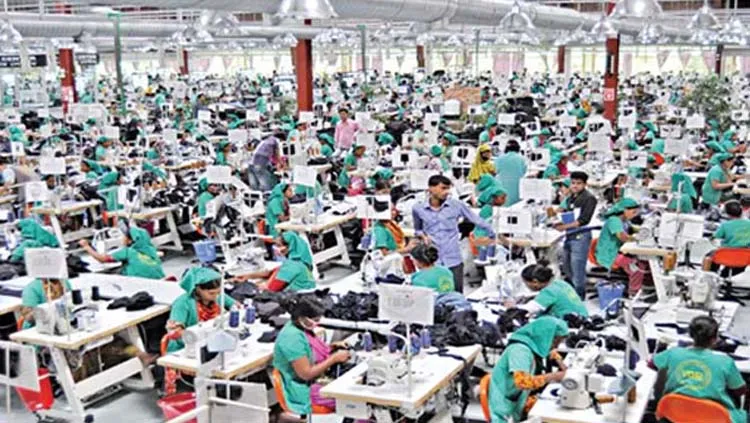
Bangladesh's readymade garment (RMG) exports to non-traditional and emerging markets have recorded a 9.30 percent growth in the first four months (July-October) of the current fiscal year 2026-27, reflecting the country's growing efforts to diversify its export destinations.
Export earnings from these markets reached US$2.37 billion during the period, up from US$2.17 billion in the corresponding period of the previous fiscal year, according to the latest data from the Export Promotion Bureau (EPB).
Turkey, Japan, Australia and South Korea have emerged as key destinations, with particularly strong growth in exports to Turkey, where shipments have more than doubled.
Talking to BSS, Adviser to the Prime Minister on the ministries of Finance and Planning, Dr Rashed Al Mahmud Titumir, said that the government, under the leadership of Prime Minister Tarique Rahman, is working to expand Bangladesh's exports in both traditional and non-traditional markets.
"The government has undertaken initiatives to develop necessary infrastructure and formulate timely policies to transform Bangladesh into a regional production and export hub. The government is pursuing the Three-R strategy to build the required capacity and institutional framework before the country's graduation from the LDC category," he said.
He added that the government aims to strengthen Bangladesh's position in the global supply chain through exploring new markets, diversifying export products and enhancing production capacity.
According to EPB data, Turkey recorded the highest growth among the non-traditional markets during July-October of FY27.
RMG exports to Turkey surged by 107.05 percent to US$206.5 million, compared to US$99.7 million during the same period last fiscal year.
The increase amounted to US$106.8 million, accounting for around 53 percent of the total growth in exports to non-traditional markets.
Turkey's share in Bangladesh's RMG exports to these markets also increased significantly, rising from 4.60 percent in the corresponding period last year to 8.71 percent during the current fiscal year's first four months.
Japan, however, remains Bangladesh's largest RMG export destination among the non-traditional markets. Exports to the country reached US$437.3 million during July-October, registering a 2.40 percent growth year-on-year. Japan accounted for 18.44 percent of total RMG exports to non-traditional markets.
Exports to Australia increased by 3.01 percent to US$264 million, while shipments to South Korea rose by 5.82 percent to US$151.3 million.
In contrast, Bangladesh's RMG exports to India declined by 5.38 percent to US$250.9 million during the period.
Exports to destinations outside the top five non-traditional markets also maintained a positive trend, growing by 8.48 percent to US$1.06 billion. These markets accounted for 44.76 percent of Bangladesh's total RMG exports to non-traditional destinations.
The positive trend continued in October alone, when RMG exports to non-traditional markets increased by 8.99 percent to US$559.7 million.
During the month, exports to Turkey grew by 75.96 percent to US$59.8 million, making it Bangladesh's second-largest destination among the non-traditional markets after Japan.
Exports to Japan stood at US$93.7 million in October, up 1.64 percent from the same month last year.
Meanwhile, shipments to Australia increased by 11.32 percent to US$55 million.
However, exports to India declined by 5.41 percent to US$45.9 million, while shipments to South Korea fell by 4.60 percent to US$30.4 million during the month.
Industry insiders believe that expanding exports to non-traditional markets will play an important role in strengthening the long-term competitiveness of Bangladesh's RMG sector.
They said sustained growth in major emerging destinations such as Japan and Turkey, alongside increased exports to other markets, would help reduce the country's dependence on a limited number of traditional export destinations.
Market diversification is also expected to help Bangladesh maintain its export competitiveness in the international market in the post-LDC graduation period.