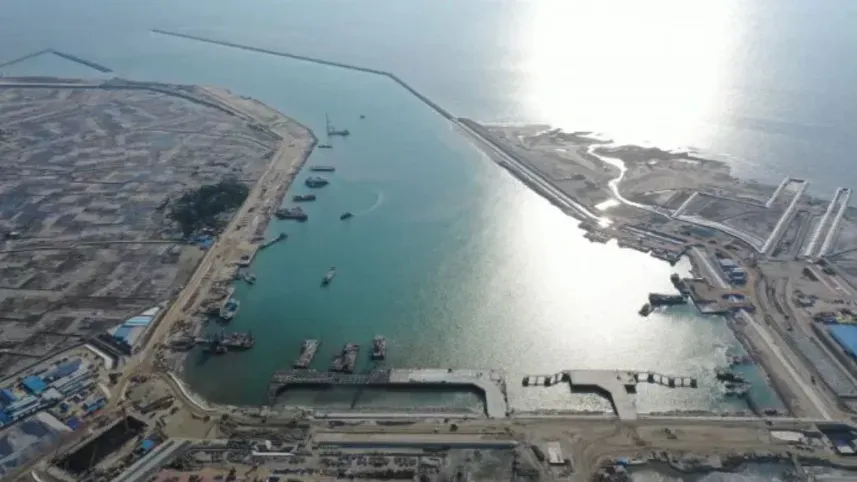
In a major judicial ruling securing the continuity of Bangladesh's premier deep-sea maritime terminal, the Appellate Division of the Supreme Court on Sunday (October 4) stayed a High Court order that had prohibited sand extraction from the Maheshkhali Channel for the Matarbari development project. The stay order was issued by the Chamber Judge of the Appellate Division following an urgent petition submitted by the state challenging the High Court's directive. High Court proceedings initiated on September 19 had previously halted dredging and reclamation operations, creating profound operational uncertainties for international engineering contractors. The Supreme Court's intervention formally removes all legal impediments to ongoing maritime construction works.
Confirming the outcome of the appellate hearing, Attorney General Md Ruhul Quddus Kazal stated that the interim High Court order had threatened to inflict catastrophic financial setbacks on the fast-track mega-infrastructure venture. He explained that large-scale reclamation works and foundation stabilisations across the port basin require continuous sand dredging from designated zones within the Maheshkhali Channel. Halting sand extraction had brought critical coastal engineering schedules to an abrupt standstill, risking significant contractual demurrage penalties and project completion delays. The attorney general emphasized that the government acted promptly to protect strategic state economic interests before higher judicial forums.
The initial legal challenge emerged from a public interest writ petition lodged by Mohammad Masum, an online journalist and local resident from the coastal Maheshkhali region. The petitioner contended that unregulated commercial sand extraction from the tidal channel was exacerbating coastal erosion, disrupting local marine fishing habitats, and damaging adjacent embankments. Responding to the writ, a High Court division bench had issued an interim stay on September 19 restraining all dredging entities from extracting seabed material for the Matarbari project. The High Court had additionally issued a rule asking relevant ministries to justify environmental clearance protocols.
Presenting the state's arguments before the Appellate Division Chamber Court, government counsels established that the dredging operations are strictly regulated under comprehensive Environmental Impact Assessments (EIAs) approved by international development partners. In addition, Including the Japan International Cooperation Agency (JICA). The attorney general argued that halting specialized dredging in navigational waterways severely jeopardised the national deep-sea port's operational commissioning timeline. He established that the targeted extraction zones are hydraulically monitored to ensure that channel navigation and coastal embankment integrity remain uncompromised throughout construction.
Summarising the legal standing outside the Supreme Court, Attorney General Md Ruhul Quddus Kazal stated, "The chamber judge's decisive stay order completely clears the way for the continuation of the Matarbari project. In addition. In addition, Ensuring that national infrastructure development faces no unnecessary judicial deadlock." Maritime engineers and project administrators at Matarbari confirmed that dredging vessels have been authorised to resume scheduled excavation and land reclamation activities immediately. Economic analysts underscored that timely commissioning of the deep-sea port remains indispensable for anchoring regional transshipment trade and sustaining Bangladesh's export logistics.