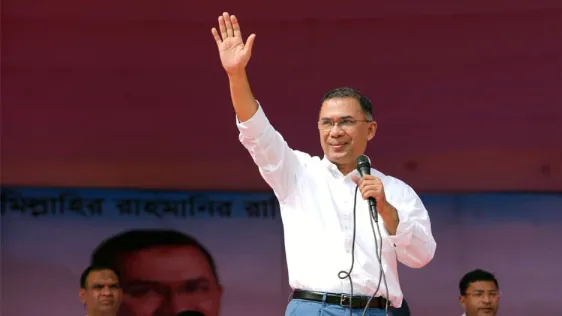
Five days after his return home amid a massive welcome less than two months ago ending 17 years exiled life, Tarique Rahman was embraced by a tragedy when her illustrious mother, Muslim world's first female prime minister Begum Khaleda Zia passed away.
But the evolving scenario ahead of the national elections in a changed political landscape in Bangladesh did not allow him spend some private days amid the personal loss as events unfolded so quickly since his return as he scarcely had time to reflect.
Bangladesh Nationalist Party (BNP), founded by his father Shaheed President Ziaur Rahman and subsequently led by his mother for decades, entrusted him with the charge of its chairmanship as the party was exposed to a state of political wilderness for years and particularly ahead of the polls.
Visibly being led by political acumen, which he is assumed to have inherited from his late parents, 60-year-old Rahman manoeuvred his party in a complicated scenario to ensure its key-stake in the politics ahead of the country's 13th general elections.
A soft-spoken Rahman drew massive crowds as he spearheaded the electioneering for his party when he explained with ardent but serious gesture his vision for the country that projected him as a statesman.
BNP won the landslide victory and he emerged as the new steward of the country.
Rahman is set to be Bangladesh's next prime minister in line with his party's decision following Bangladesh's one of the most pivotal elections.
"The election marked a remarkable reversal of fortune for the soft-spoken 60-year-old, who left the country in 2008 saying he needed medical treatment after his release from detention under a military-backed caretaker administration," a global media outlet recently commented in an article on Rahman.
Another global outlet remarked "the symbolism of his return - visible, accessible, and leading from the front - carried its own power, tapping into a grassroots base that traces back to his father, General Ziaur Rahman, a former military leader whose legacy shaped the BNP before his assassination in 1981".
Yet, it commented, the enthusiasm had "increasingly been accompanied by unease, resulting in an election campaign defined as much by anticipation as by doubt".
The anticipation and the doubt has now largely faded out but Rahman is now exposed to a new challenge in his new crucial role as the next premier in parliamentary form of government in unitary system of Bangladesh.
French leader General Charles de Gaulle had led the French part of the allied war from exile in London during the World War 2 ahead of his return to Paris to take the charge of his country as its president.
Rahman's case appeared to be nearly identical as he landed home from exile, from where he steered his party as the acting chairman, and now returned home from the UK to take the command in person.
Living more than 8,000 kilometers away, Rahman, like the French leader, remained a central figure in national politics, spearheading what his party describes as a protracted campaign to restore democratic norms, values and voting rights.
"We need to ensure a normal situation in the country, so that people are safe," he said in an interview ahead of the polls, adding what was needed at the moment in the country was "peace and stability", visibly outlining his immediate goal.
Since his returning, Rahman also noticeably adopted an understated style by avoiding inflammatory rhetoric and calling instead for restraint and reconciliation.
Hours after his return Rahman said, "I have a plan" which he later gradually unfolded pledging to recalibrate Bangladesh’s international partnerships to attract investment without tying the country too closely to any single power.
He aims to expand financial aid for poor families offering "family cards", reduce reliance on garment exports by promoting industries such as toys and leather goods, and introduce a two-term or 10-year limit for prime ministers to deter autocratic tendencies.
In several interactions Rahman acknowledged the task ahead of him in the country of 170 million people would be daunting with recovery of a shattered economy being a key-.challenge.
He repeatedly said the economy appeared to him as a very serious challenge ahead which would need to be tackled through a well designed plan while the health sector alongside the energy issue would be on his priority list.
"We expect that we will have a clear mandate from the people -- a big mandate," he said ahead of the election and now he got it to guide the country as he planned for the good of the country.