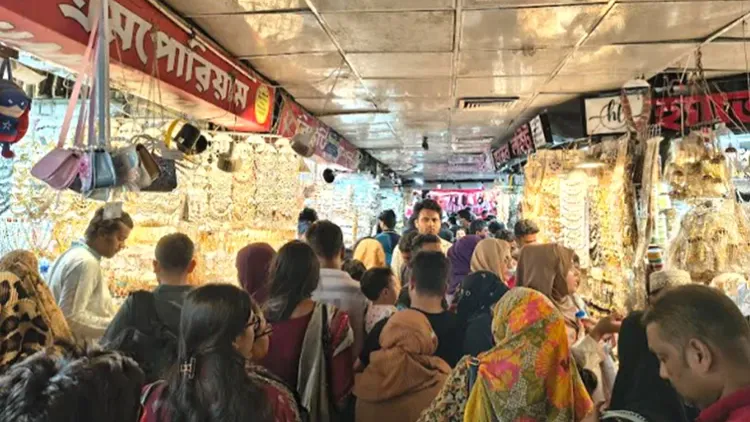
As the sun dips below the horizon and the call to Iftar echoes across the city, something electric happens at Dhaka's New Market. The footpaths fill. The air hums. Families, couples, and friends pour in from every corner of the capital and beyond, all chasing the same dream: the perfect Eid outfit.
For millions of Bangladeshis, New Market is more than a shopping destination. It is a tradition. Tucked in the heart of Dhaka, this sprawling marketplace has long been the go-to haven for middle- and working-class families who refuse to let tight budgets dim the joy of Eid-ul-Fitr. And this year, as Ramadan draws to a close, the market is busier and perhaps happier than it has been in years.
A Season of Unexpected Relief
Step inside on any evening this week and you will find something shopkeepers had quietly been hoping for: stability. After years of price volatility that left both buyers and sellers anxious, the mood this Eid season feels different.
"In comparison to previous years, the market has remained stable and so have the prices," says Md. Jashim Uddin, who runs a vanity bag stall outside Nur Mansion. He has worked this corner long enough to read the seasons. "There has been no sudden jump in prices as Eid approached. Things stayed as they were," he smiles, adjusting a row of glittering bags. "People are buying freely."
A few steps away at New Super Market, Mohammad Raju, who owns Linkin Park, a gents' clothing shop, shares the same quiet satisfaction. "The sales have exceeded my expectations this year," he says. "And there are no security concerns either." He credits the calmer commercial atmosphere to a broader sense of political stability. "After the peaceful election, the market found its footing again. Everything that affects market balance has remained steady."
For the Little Ones First
If there is one constant in Eid shopping across income levels, it is this: the children come first.
Mohammad Masum, who runs Cotton Gallery, a shop dedicated entirely to kids' clothing, has watched this play out year after year. "People specially come to buy for their children," he says, surveying a shop packed with tiny kurtas, frocks, and little shoes. "Buyers rush in here."
He pauses, his voice softening. "Even people with lower incomes may not buy much for themselves, but will always try to get something new for their kids. That is why the sale of children's clothing is always higher than anything else during Eid." He looks satisfied, even moved. "It warms you, honestly."
Stories from the Crowd
The true heartbeat of New Market, though, lives in the people weaving between its stalls.
Md Arif made the journey from Mirpur with four friends, a cheerful pack navigating the evening crowds. "Everything is within our buying capacity," he says simply, inspecting a shirt.
"No shortage. Whatever you need, you can find it."
Then there is Md Juber, who arrived in Dhaka not for shopping, but for a medical appointment. From Chattogram, he found himself at New Market almost by accident and seized the opportunity. "Prices here are comparatively cheaper," he explains, his wife browsing a rack beside him. "So we decided to finish our Eid shopping before heading back home."
A young couple, Ridoy and Mithila, came all the way from Kamrangirchar in the south of the capital. Hand in hand, bags already in tow, they are candid. "There is a slight increase in some prices," Ridoy acknowledges. "But it is still within range. We managed well."
Perhaps the most touching story belongs to Maksud Islam, also from Kamrangirchar, who arrived not to shop for himself but to guide his two friends, Paven and Foisal, who had traveled all the way from their hometown of Sonaimuri in Noakhali. "They came for Eid shopping for their siblings and family back home," Maksud says, watching his friends hold up fabrics to the light. "I am just here to show them around." He grins. "I'm not buying anything today."
A City Preparing for Celebration
Long after Iftar, New Market refuses to sleep. Street vendor Md Suman, who sells women's dresses from a pavement stall, knows this rhythm well. "People come after Iftar and the market stays open until midnight during Eid season," he says, straightening his display as the evening crowd thickens around him.
It is a ritual as old as the market itself - the night air carrying the scent of new fabric and street food, children holding their parents' hands, old friends bumping into each other between stalls, strangers bargaining side by side.
In a city that has weathered its share of uncertainty, New Market in Eid feels like a deep, collective exhale. Prices are bearable. Shelves are full. And the people of Dhaka, from Mirpur to Noakhali, from Chittagong to Kamrangirchar, are here, spending what they can, celebrating as best they know how.