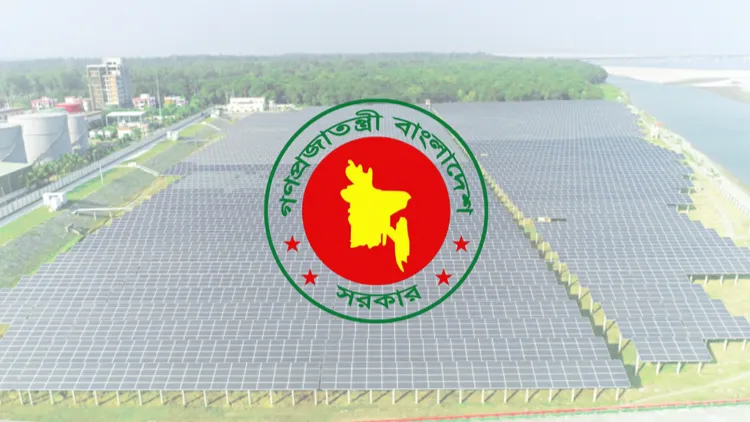
The government expects 809.5 megawatt (MW) solar power to be produced by end 2028 as part of its green energy campaign while its current production quantum is 1,451 MW that accounts for some 5.01 percent of the country’s total installed power capacity.
This (production initiative) is part of the government’s integrated plan to boost renewable energy, cut carbon emissions and strengthen energy security,” Bangladesh Power Development Board (BPDB) Chairman Engineer Rezaul Karim told BSS here today.
He said BPDB’s now targeted to add 809.5 MW to the national power grid by the end of 2028.
“We are implementing the government’s integrated plan to boost renewable energy, cut carbon emissions and strengthen energy security in the country,” chairman of BPDB Engineer Rezaul Karim told BSS here today.
Energy analysts said that the rooftop solar and other renewable projects could significantly reduce Bangladesh’s reliance on imported fuel.
BPDB officials said they by now invited tender for 13 solar power projects to produce 572.6 MW while nearly 5 MW additional solar rooftop power panels were installed by now which would be operational by September this year.
They said 26 renewable power plants having 1,174 MW were under construction, six being executed by the government and 20 having 1,062-MW capacity by private sector.
BPDB’s records suggest as of May 2026, the total grid-based installed power generation capacity in the country is 28,919 MW and if the quantum of captive power, generated by industries for their own use, and off-grid renewable energy are calculated the quantum stands at 32,332 MW.
The actual production on Saturday was 10,755 MW while in April 2024 the quantum was 16,477 MW.
The estimated peak power demand is approximately 18,000 MW to 18,500 MW during the current summer season.
Bangladesh currently produces 1,450.67-MW solar electricity while 1,073.5 MW are connected to the national grid and 377.17 MW are off-grid.
Of the renewable sources 230 MW comes as hydroelectricity, 62 MW is produced from wind, 0.69 MW from Biogas and 0.4 MW from Biomass.
Sustainable and Renewable Energy Development Authority (SREDA) studies suggests Bangladesh has about 1743.76 MW of installed renewable capacity with sources being solar parks, rooftop net metering, and solar home systems (SHS).
State-run Rural Power Company Limited (RPCL) is installing a 100 MW capacity solar park at Jamalpur’s Madarganj which is expected to be operational in December 2026.
The private sector or independent power producers (IPPs) are expected to provide 132 MW to the grid.
Energy minister Iqbal Hasan Mahmood on Tuesday told the deputy commissioners annual conference that the government set a target to generate 5,000 MW solar power in next five years.
“As a primary step toward achieving this goal, directives have been issued to install solar panels at offices of all deputy commissioners (DCs) across the country in next three months,” he said.
Leading energy analyst Shafiqul Alam suggested the government should develop a comprehensive energy master plan to ensure policy consistency as it was needed to rebuild investors’ confidence.
“Bangladesh currently experiences stagnation in renewable energy development as no initiative was taken in the past interim government,” said Alam, who serves at independent Institute for Energy Economics and Financial Analysis (IEEFA).
According to the existing target 20 percent of the electricity will come from renewable sources by 2030 and 30 percent by 2041 in line with the UN’s Sustainable Development Goal 7 (SDG 7).
“If the government installs a solar panel having generation capacity 1.0 MW then import to be reduced of Taka 2.94-3 crore,” Coastal Livelihood and Environmental Action Network (CLEAN) chief executive and energy expert Hasan Mehedi said.
He said that if the government could encourage people to install rooftop solar at their households the government investment would not be required.
Mehedi said some 13000 acres of land was acquired earlier to construct coal-fired power plants but they remained unused so far.
“Instead of new land acquisition, these pieces of land now could be used to set up solar plants which would reduce price per unit by 23-25 percent,” Mehedi said.
International Renewable Energy Agency’ (IRENA) latest report suggests the World renewable energy producers using solar. Of them China emerged as the number one solar energy producer generating 12,02,178.8-MW followed by the USA producing 2,11,610.1 MW and India producing 1,35,501.5 MW.
They are followed by Germany producing 1,06,272 MW, Japan 92,211.3 MW, Brazil 64,692.3 MW, Spain 47,205.6 MW, Italy 41,187.9 MW, Australia 41,067.9 MW and France 31,226.2 MW.
As far as the national grid connection is concerned Vietnam currently provide 8700 MW solar power to its grid, Philippine 2,600 MW, Sri Lank 1000 MW and Pakistan 800 MW.
Sri Lanka targets to generate 70 percent of its electricity from renewable energy sources by 2030 while solar power is generally regarded as a significant success story in the island country, particularly in the realm of decentralized rooftop solar installations.
Driven by the national "Soorya Bala Sangramaya" or “Battle for Solar programme”, rooftop solar capacity witnessed rapid growth there, surpassing 1,700 MW by May 2025.
In South Asia Pakistan appeared as one of the world's fastest solar energy producers with its current installed solar capacity of at least 32,000 MW while its plans to produce 60 percent of electricity from renewable energy sources by 2030.
An analysis by UK-based The Guardian said after prices of liquefied natural gas surged to record highs after Russia’s full-scale invasion of Ukraine in 2022, millions of people in Pakistan were repeatedly left without electricity amid an intense heatwave and gas shortages.