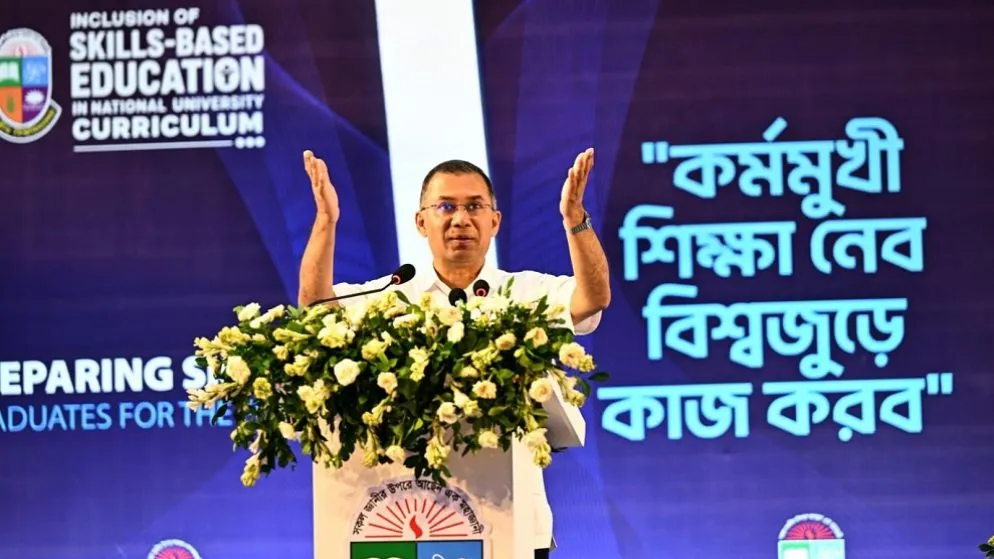
Prime Minister Tarique Rahman on Sunday inaugurated a nationwide training programme for college teachers aimed at integrating skills-based and technical education into the National University (NU) curriculum.
The programme, titled “Inclusion of Skills-Based Education in National University Curriculum”, was formally launched at the Bangladesh-China Friendship Conference Centre in the Agargaon area of the capital.
The Prime Minister inaugurated the initiative by pressing a button on a laptop at around 11:25am.
Under the programme, the National University has taken the initiative to build a skilled teaching workforce capable of delivering employment-oriented and technical education. A total of 12,000 college teachers from across the country will be trained in phases.
Speakers at the event underscored the importance of vocational and technical education, highlighting the slogan: “We will receive skills-based education and work across the world.”
During the programme, NU Vice-Chancellor Professor ASM Amanullah and other teachers presented the Prime Minister with a commemorative crest and a sapling.
At the beginning of the event, a documentary was screened highlighting the life and contributions of late President Ziaur Rahman, former Prime Minister Begum Khaleda Zia, and Prime Minister Tarique Rahman.
Education Minister Dr ANM Ehsanul Hoque Milon, Education Adviser to the Prime Minister Mahdi Amin, and Professor Amanullah also addressed the programme.
Officials said the revised curriculum will include training in freelancing, entrepreneurship development, digital marketing, cybersecurity, artificial intelligence, machine learning and data science.
To support implementation, 900 master trainers have already been prepared. They will subsequently train the 12,000 teachers nationwide, enabling them to deliver the new courses effectively and equip students with skills aligned with modern labour market demands.
The initiative is expected to strengthen employment-oriented education and enhance graduates’ competitiveness both at home and abroad.