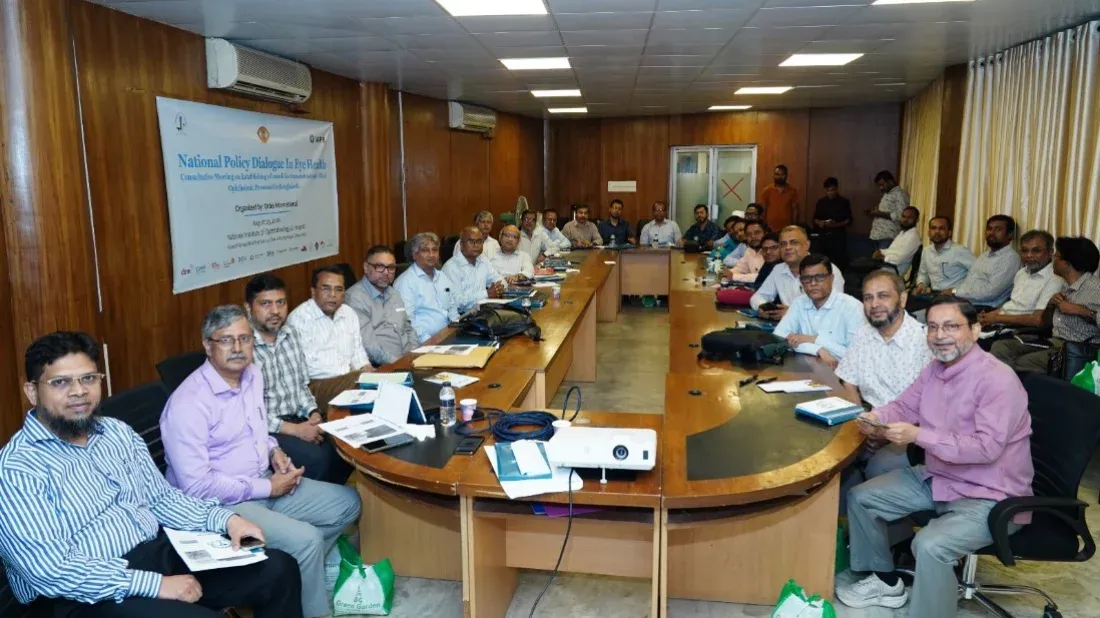
Leading ophthalmologists, public health experts, and clinical stakeholders have reached a consensus on the urgent necessity of establishing a dedicated Optometry Council under the Ministry of Health and Family Welfare to systematically integrate, standardize, and regulate optometrists and allied ophthalmic personnel across Bangladesh.
The consensus was reached on Tuesday during a high-level policy forum titled “National Policy Dialogue on Eye Health: Consultation on Establishing a Council for Optometrists and Allied Ophthalmic Personnel in Bangladesh,” organized by Orbis International at the National Institute of Ophthalmology and Hospital (NIO&H) in Dhaka.
While participants unanimously advocated for mainstreaming allied eye care professionals to bridge massive human resource deficits in rural and primary healthcare tiers, clinical leaders underscored the critical importance of instituting clear statutory boundaries regarding their scope of practice, particularly concerning pharmaceutical prescriptions.
Emphasizing the regulatory void, Prof. Dr. A.S.M.M. Quadir, Acting Director of NIO&H, observed:
"A statutory regulatory body is indispensable to formulate prerequisite academic criteria for entering optometry education, define whether optometrists may prescribe specific medications, and determine whether they should practice independently or under the clinical supervision of certified ophthalmologists."
Concurring with this view, Ophthalmological Society of Bangladesh (OSB) Secretary General Prof. Md. Zinnu Rain stressed that rigid parameters must govern drug prescriptions, asserting that optometrists should never be authorized to prescribe potent pharmaceutical agents such as systemic antibiotics or steroids.
OSB President Dr. Md. Touhidur Rahman called for nationwide curriculum standardization across intermediate eye care courses, noting that sustainable progress requires integrating all components of eye health infrastructure through active government policy intervention.
OSB Treasurer Dr. Syed Mehboob Ul Quadir highlighted that although optometrists play a pivotal clinical role in neighboring countries like India, Bangladesh’s public healthcare framework has yet to formally accommodate them into government hospital organograms. He stressed establishing a structured monitoring framework to ensure practitioners remain strictly within their legally mandated roles.
Moderating the dialogue, Dr. Munir Ahmed, Country Director of Orbis Bangladesh and Honorary Country Chair of the International Agency for the Prevention of Blindness (IAPB), warned that severe shortages of trained clinical personnel hinder national progress toward global healthcare targets, including the newly adopted WHO SPECS 2030 initiative.
Underscoring the escalating demand for eye care, Dr. K. Zaman BNSB Eye Hospital Executive Director Sharifuzzaman Parag noted that nearly 20 percent of the national population currently requires clinical ophthalmic care, heavily outstripping the existing institutional capacity and workforce. Jahurul Islam Jewel, Senior Program Manager at CSF Global, urged the Ministry of Health and Family Welfare to expedite the formation of the council to officially recognize and accredit optometric professionals.
The policy dialogue also featured contributions from OSB Vice President Prof. Md. Sayedul Huq, Rajshahi Medical University Registrar Prof. Dr. Md. Shah Alam, Bangladesh Optometric Society President Md. Didarul Islam, University of South Asia School of Public Health and Life Sciences Dean Dr. Anisur Rahman, Chittagong Eye Infirmary and Training Complex (CEITC) Medical Director Dr. Rajib Hossain, Deep Eye Care Foundation Executive Director Dr. Khairul Islam, and Bangladesh National Society for the Blind (BNSB) Cumilla General Secretary A.K.M. Abdus Salim.