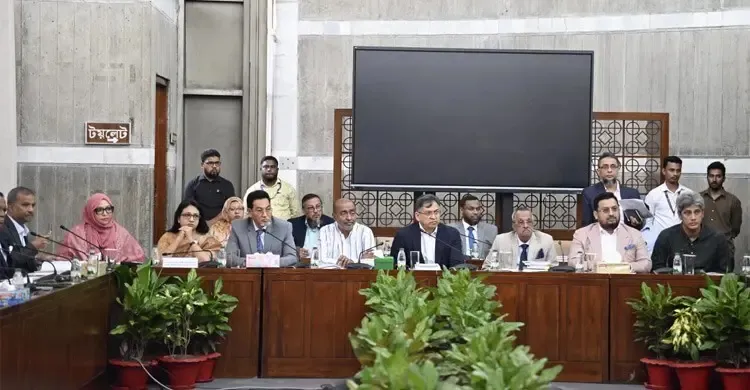
The Special Committee on Constitutional Reform has deliberated on alternative mechanisms for structuring an election-time caretaker government, reviewing proposals to draw its leadership and advisory council from a proposed Upper House or appoint a consensually elected Speaker as its chief.
Speaking to journalists following a consultation with constitutional experts, law professors, and Supreme Court advocates at the National Parliament on Saturday (October 24), Special Committee Chairman and Home Minister Salahuddin Ahmed stated that multiple institutional models were examined. Key ideas included utilizing a permanent Upper House—should a bicameral parliament be introduced—to constitute the caretaker administration after the dissolution of the Lower House, potentially creating a Vice President post within the chamber to assume leadership.
An alternative proposal suggested appointing the Speaker of Parliament as the head of the interim administration, provided the individual is elected with the joint consensus of both the treasury and opposition benches. Under this model, remaining advisers would also be inducted from the Upper House through bipartisan agreement. Salahuddin Ahmed noted that the discussions explored how to establish an interim administration based entirely on political consensus while keeping the judiciary out of election administration and eliminating the contentious default option of the President assuming the role.
Beyond the caretaker framework, the meeting addressed broader structural reforms: establishing a dedicated, independent secretariat for the judiciary; instituting a checks-and-balances mechanism between the President and the Prime Minister; setting a four-year tenure for the Lower House and six years for the Upper House; ensuring representation for all 64 districts and ethnic minorities; and conferring constitutional status upon the Anti-Corruption Commission and the National Human Rights Commission.
Participants also proposed allocating the chairmanships of key parliamentary standing committees—including Public Accounts, Public Undertakings, Foreign Affairs, and Home Affairs—to the opposition, introducing direct elections for reserved women's seats, and creating independent selection committees for constitutional appointments. Addressing historical precedents, Salahuddin Ahmed stated that the current process will not repeat the arbitrary outcome of the 2011 constitutional review, affirming the committee's commitment to democratic consensus.
Attendees at the meeting included Professor Dr. Salimullah Khan, Supreme Court Bar Association President and MP A. M. Mahbub Uddin Khokon, Secretary Mohammad Ali, senior jurist Dr. Shahdeen Malik, Raghib Rauf Chowdhury, Professor Dr. Muhammad Ekramul Huq, Professor Dr. Borhan Uddin Khan, and Barrister Tanim Hossain Shawon.