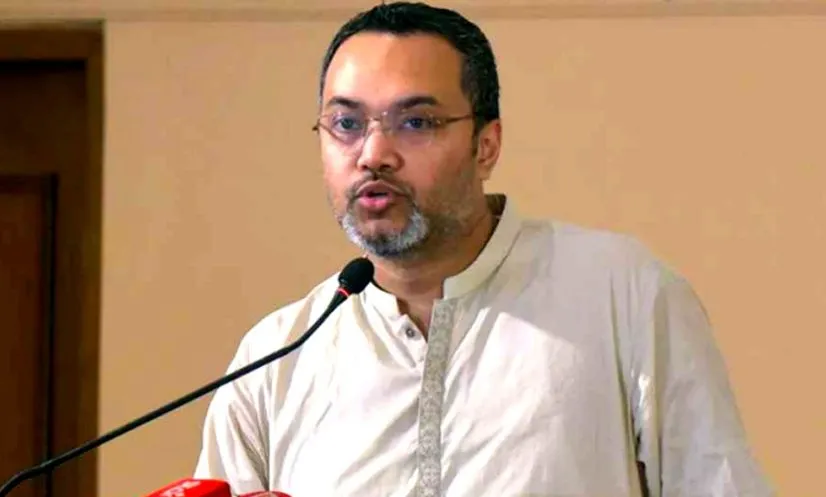
Mahdi Amin, Adviser to the Prime Minister and Spokesperson for the Prime Minister’s Office (PMO), stated that the elected BNP administration has guaranteed unprecedented freedom of expression and civil human rights across Bangladesh over the past seven months.
Addressing a symposium titled "Democracy, Human Rights, and Accountable Governance" organized by Transparency International Bangladesh (TIB) in Dhanmondi, Amin remarked that while it remains arduous to eliminate overnight the accumulated debris of a 17-year autocracy, the operational reality of the past seven months shows zero state-sponsored human rights violations. He asserted that there have been no state-backed enforced disappearances, no extrajudicial encounters, no custodial fatalities under torture, and no state-orchestrated suppression of divergent political philosophies, paths, or values of the opposition.
Elaborating on the phrase "state-sponsored," the PMO spokesperson underscored that under the previous regime, opposition figures were systematically cataloged directly by top state executives or designated public bureaus for aggressive state interventions. In contrast, under the current democratic architecture, should any isolated undesirable incident or bureaucratic oversight occur at the local level, it is immediately subjected to institutional accountability. He stressed that swift remedial legal actions are initiated as soon as infractions surface, institutionalizing the rule of law.
Amin emphasized the government’s resolve to make this democratic momentum permanent. Rather than covering up local-level lapses as was customary in the past, authorities act on complaints and intelligence with swift investigative and corrective procedures. Dismantling the centralized culture of state repression to validate grievances from the grassroots represents an essential qualitative shift in statecraft, which the administration aims to solidify further in the days ahead.
Reflecting on the July mass uprising, Amin noted that the historic movement belonged to no solitary political party or isolated demographic. Across society, students from schools, colleges, madrasas, and universities joined alongside ready-made garment workers, rickshaw pullers, expatriate remitters, women, academics, jurists, physicians, and journalists, each playing transformative roles from their respective stations to build a singular national consensus against autocratic governance.
Regarding stakeholder consultations on legislation, the spokesperson explained that over one hundred ordinances promulgated during the previous interim government were converted into full statutory laws during the maiden session of the current parliament—a legislative volume rarely witnessed within such a compressed timeframe. For newly drafted enactments, drafts were published well in advance to aggregate civil feedback, recognizing that statutory lawmaking is an iterative process. Lawmakers are striving to incorporate popular sentiment following 17 years of misrule; while an initial draft may not achieve perfection instantly, the administration remains receptive to introducing amendments where realistic stakeholder inputs warrant revision.
He added that Prime Minister Tarique Rahman has given direct and unequivocal instructions to sustain intensive engagements with constructive interlocutors to ensure statutes remain citizen-friendly and pragmatic. The administration maintains that practical, equitable statutory implementation matters far more than mere statutory language, noting that constitutional clauses were previously distorted to disenfranchise citizens and obliterate human rights.
Embracing the spirit and collective aspirations of the July uprising, the country is experiencing peak free speech, where the government maintains maximum tolerance and peaceful coexistence despite instances of unseemly or indecent criticism. Amin appealed for steadfast national solidarity over core questions of independence, sovereignty, and public interest under a "Bangladesh First" doctrine.
Tracing political history, Amin asserted that the BNP has consistently anchored the restoration of democracy across pivotal national junctions, noting how martyred President Ziaur Rahman reinstated multi-party democracy after the BAKSAL era, Begum Khaleda Zia oversaw the restoration of parliamentary democracy following autocratic military rule, and Prime Minister Tarique Rahman has now steered Bangladesh back onto its constitutional and democratic trajectory.
The spokesperson reiterated that the current government is building an inclusive state where sovereign ownership belongs strictly to the citizens. He noted that during the past 17 years, more than six million BNP leaders and activists faced fabricated legal cases, alongside thousands who were martyred or forcibly disappeared. Looking forward, the administration envisions driving progress by positioning civil society, the press, the private sector, and particularly youth and women as central drivers of statecraft.
Moderated by TIB Executive Director Dr. Iftekharuzzaman, the discussion was also addressed by BNP International Affairs Secretary Barrister Muhammad Naushad Zamir, BSD Central Committee Member Dr. Manisha Chakraborty, and physician and youth politician Tasnim Jara, alongside senior journalists, academicians, civil society figures, and student representatives.