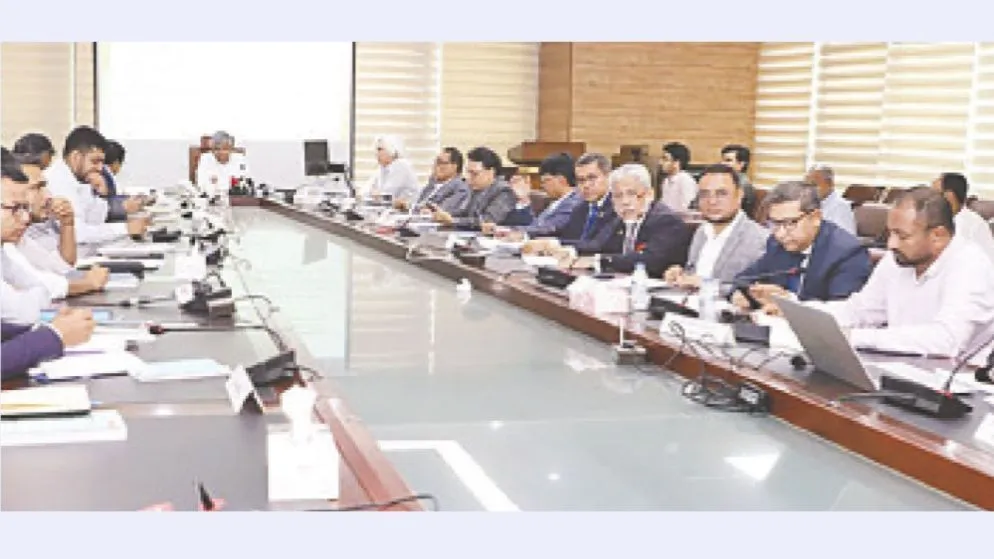
Anwar-ul Alam Chowdhury Parvez, President of the Bangladesh Chamber of Industries (BCI), has said that businesses are required to pay a minimum turnover tax of 1 percent even when they incur losses, describing it as a “burden” on enterprises. He also noted that many foreign buyers are suspending purchase orders over fears that the country could face a fuel shortage within the next two to three months.
He made these remarks on Wednesday (22 April) during a pre-budget discussion for the 2026–27 fiscal year, held at the National Board of Revenue (NBR) conference room in Agargaon, Dhaka.
The meeting was attended by NBR Chairman Md Abdur Rahman Khan, senior officials of the organisation, and representatives from various business associations.
Parvez said foreign buyers are concerned that Bangladesh may run out of fuel within the next two to three months, prompting them to divert orders to countries such as India. He warned that this trend could push the country’s economy—and the ready-made garments (RMG) sector, its main source of foreign currency earnings—into a deep crisis.
He added that amid the ongoing conflict in the Middle East and fears of an energy shortage, foreign buyers of garments are increasingly shifting to India and other countries. The volume of orders expected for July and August has slowed significantly, and several major buyers have already begun sending negative signals. While Dhaka-based offices are attempting to manage the situation, top management at buyer companies is becoming reluctant to place new orders in Bangladesh.
The BCI president further stated that due to instability in the global market, power shortages and various domestic constraints, many potential orders for July and August have stalled. At the same time, the existing tax structure has become a major burden for small entrepreneurs.
Describing the current tax system as unrealistic amid a business downturn, he said that paying a minimum tax of 1 percent regardless of profit or loss has become difficult for many firms, particularly small enterprises. Bringing small entrepreneurs under a structured tax slab could help them survive, he added, noting that businesses are often required to pay taxes even without making profits, placing their very existence at risk. In this context, he demanded that the source tax on export earnings be reduced from 1 percent to 0.5 percent.
However, the NBR Chairman rejected the proposal to reduce the source tax.
Meanwhile, the Dhaka Chamber of Commerce and Industry (DCCI) has proposed full automation of the revenue structure in the 2026–27 budget to increase the tax-to-GDP ratio. It also recommended reducing the corporate tax rate for non-listed companies from 27.5 percent to 25 percent, raising the tax-free income threshold for individuals to Tk500,000, lowering advance tax on commercial imports from 7.5 percent to 5 percent, and fully automating the customs refund system.
At the same pre-budget meeting, DCCI Acting Secretary General Dr AKM Asaduzzaman Patwary presented a summary of 54 proposals related to income tax, value-added tax (VAT) and import duties to the NBR Chairman for inclusion in the national budget.
At the outset, MBM Lutful Hadi, convenor of DCCI’s Customs and VAT Standing Committee, said the chamber had prioritised expanding the tax net, enhancing revenue collection capacity, creating a business-friendly environment, reducing the tax burden, boosting employment and supporting investment in productive sectors. These measures, he said, would lower business operating costs, increase government revenue and have a positive impact on the overall economy.
In the discussion, the acting secretary general also emphasised the introduction of a central API integration system by coordinating data among all government service-providing agencies to expand the tax net and reduce revenue gaps. He further proposed reducing the tax deducted at source on interest from company deposits from 20 percent to 10 percent and gradually abolishing the surcharge on net assets. Additionally, he called for removing the upper limit on VAT refunds and introducing mobile applications to increase VAT collection, alongside comprehensive automation of the VAT system.