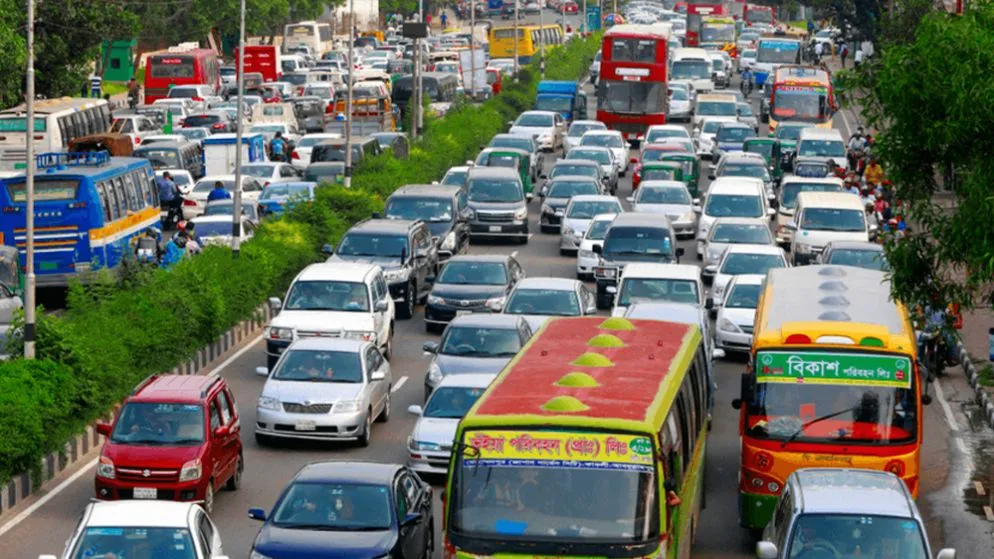
The government is losing a significant amount of revenue every year from the country’s transport sector. At present, annual revenue from five major segments—motorcycles, three-wheelers, buses and minibuses, trucks and covered vans, and private cars—stands at Tk3,983 crore.
However, if the existing system were fully enforced, this could rise to around Tk7,500 crore. This means the government is losing approximately Tk3,517 crore annually due to weak management, lack of monitoring, and irregularities.
A recent analysis highlights that vehicle registration, fitness fees, route permit fees, import duties, supplementary duties, and annual taxes could be major sources of government revenue. In reality, however, these sources are not being fully utilized. Sector insiders say that proper enforcement of laws and policies could nearly double revenue from this sector.
According to stakeholders, the main reasons for the shortfall include the widespread operation of unfit, unregistered, and expired vehicles. Additionally, vehicles operating without route permits and widespread tax evasion are major contributing factors.
Sector-wise data shows that motorcycles generate the second-highest revenue, but there is still a large gap. Currently, about Tk1,360 crore is collected annually from this segment, while the potential exceeds Tk2,001 crore—indicating a loss of around Tk641 crore. It is estimated that nearly 400,000 motorcycles are operating without valid fitness certificates or registration renewals.
Revenue from CNG and LPG-powered three-wheelers currently stands at about Tk362 crore, while the potential is nearly Tk880 crore, resulting in a loss of approximately Tk517 crore. The situation is even more alarming in the battery-powered easy bike segment. Current revenue is only Tk17.5 crore, whereas potential earnings exceed Tk905 crore—indicating a loss of around Tk888 crore. It is estimated that 400,000 to 500,000 easy bikes are operating without registration.
In the bus and minibus sector, complications related to route permits and fitness certification are causing major revenue losses. Currently, about Tk198 crore is collected, while the potential is Tk670 crore. In the truck and covered van segment, revenue stands at Tk275 crore, but proper enforcement of transport laws could increase it to Tk697 crore. The private car segment is also losing about Tk560 crore due to tax evasion and failure to renew fitness certificates on time.
Stakeholders note that these losses are not only economic but also pose serious risks to the environment and road safety. According to the World Health Organization, around 31,578 people die annually in road accidents in Bangladesh, although official police records show much lower figures—5,380 in 2024 and 4,636 in 2022. Experts believe that unauthorized and unfit vehicles are among the main causes of such accidents.
Under the Road Transport Act, 2018 of Bangladesh, the economic lifespan of buses is set at 20 years, trucks at 25 years, and CNG/LPG three-wheelers at 15 years. Although motorcycles do not have a fixed lifespan, a valid fitness certificate is mandatory. Existing regulations, including the Road Transport Rules, 2022 and the Motor Vehicle Scrap and Recycling Policy, 2026, require the disposal or scrapping of expired and unfit vehicles. However, according to data from the Bangladesh Road Transport Authority, around 568,000 registered vehicles did not have valid fitness certificates as of April 2023, with the number increasing by 20–30 percent annually. These vehicles, especially outdated and unfit buses and trucks, are responsible for about 10–15 percent of overall air pollution in Dhaka.
Experts say that the uncontrolled movement of unregistered, expired, and unfit vehicles is a major cause of severe environmental pollution and road accidents, directly affecting public safety across the country.
Leaders in Bangladesh’s automobile sector say the transport industry could be a major source of government revenue. However, despite having laws and policies in place, weak implementation is causing significant losses. Without strict action against unregistered and unfit vehicles, the situation may worsen.
They also point out that the vehicle manufacturing and assembly industry is gradually developing in the country. To protect this sector, import policies need to be rationalized, and vehicle registration and fitness systems must be made fully digital and mandatory. Proper enforcement of these measures would not only increase revenue but also benefit the industrial sector.
A transport sector leader, speaking on condition of anonymity, said that although the processes for fitness certification and tax payment are relatively simple, weak enforcement allows many to exploit loopholes. Without ensuring penalties, the situation will not improve.
Transport analysts believe the core problem lies in weak data management. Databases related to registration, fitness, taxation, and route permits are not yet fully integrated, allowing many vehicles to remain outside monitoring systems.
A former government official suggested that creating an integrated digital database containing all vehicle-related information would significantly reduce tax evasion and irregularities.
Stakeholders recommend several urgent measures to address the situation. These include making fitness and registration renewal mandatory, bringing unregistered vehicles such as easy bikes under legal frameworks, digitizing the route permit system, strengthening mobile courts and monitoring, and implementing scrapping policies to remove expired vehicles from the roads.
They also cite India’s 2021 Voluntary Vehicle-Fleet Modernization Program, which mandates fitness testing for private vehicles older than 20 years and commercial vehicles older than 15 years. Vehicles that fail the test are declared end-of-life and must be scrapped at registered facilities in exchange for a certificate of deposit. By December 2025, about 394,000 vehicles had been scrapped across 21 states and union territories in India, with a target of scrapping over 500,000 vehicles annually by 2026.
Experts conclude that with proper planning, use of technology, and strict enforcement of laws, the transport sector could become one of the government’s largest sources of revenue. However, under current conditions, much of this potential remains untapped.