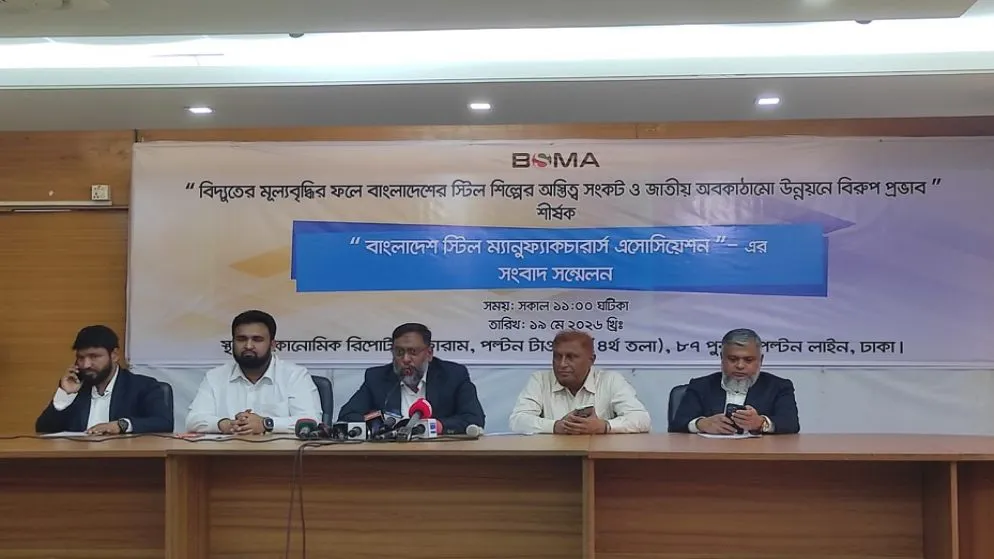
Leaders of the Bangladesh Steel Manufacturers Association (BSMA) on Tuesday urged the government not to increase electricity tariffs for the steel industry amid mounting challenges, including rising global fuel and raw material prices.
The call was made at a press conference held at the auditorium of the Economic Reporters’ Forum (ERF) in the capital.
Reading out a written statement, BSMA President Mohammad Jahangir Alam also urged the government to reconsider and reduce what he termed unreasonable demand charges and additional VAT, alongside reviewing the policy of imposing extra charges based on power factor.
He further demanded a gradual reduction and eventual elimination of capacity charges, as well as uninterrupted and quality electricity supply for industries.
Jahangir Alam, who is also Managing Director of GPH Ispat Limited, called for the introduction of a special industrial tariff for high-voltage consumers and the provision of interest or adjustment facilities against security deposits paid by industries.
He also stressed the need for a long-term, investment-friendly energy policy to support industrialisation.
Explaining the current situation, Jahangir said industrial electricity tariffs have increased by nearly 30 per cent in recent years, while gas prices in some cases have risen by almost 300 per cent.
He also called for a review of capacity payments in the power sector, claiming that more than Tk50,000 crore is paid annually as capacity charges.
Speaking at the event, BSMA Secretary General Dr Sumon Chowdhury said Bangladesh’s business community and overall economy have been facing significant challenges since the post-Covid period.
He noted that around 30 per cent of the steel industry’s total production cost is linked to electricity consumption.
“The previous Awami League government increased electricity prices in several phases and also raised gas prices multiple times. These repeated hikes have already created a major burden on the industrial sector,” he said.
“However, following the recent political transition, we now feel a sense of relief and renewed confidence. We believe the present government is business-friendly and understands the difficult situation facing the country’s industries. We hope it will take the necessary steps to address these challenges,” he added.
Dr Sumon Chowdhury said the country’s steel industry currently has an annual production capacity of around 12 million tonnes, but despite this substantial capacity, the sector is going through a difficult period due to falling market demand.
He said the national demand for steel previously stood at around 7 to 7.5 million tonnes annually, but consumption has now declined to between 4 and 5 million tonnes a year.
“One of the key reasons behind this decline is the slowdown in government infrastructure spending and development activities, as we understand the government is considering reducing expenditure in this sector,” he said.
He warned that sustainable national development and economic progress could not be achieved without continued investment in infrastructure and industrial growth.
Among others, BSMA Founder President Sheikh Masadul Alam, Managing Director of CSRM Md Shahjahan, and Chairman of Salam Group Md Rezaul Karim also spoke at the event.