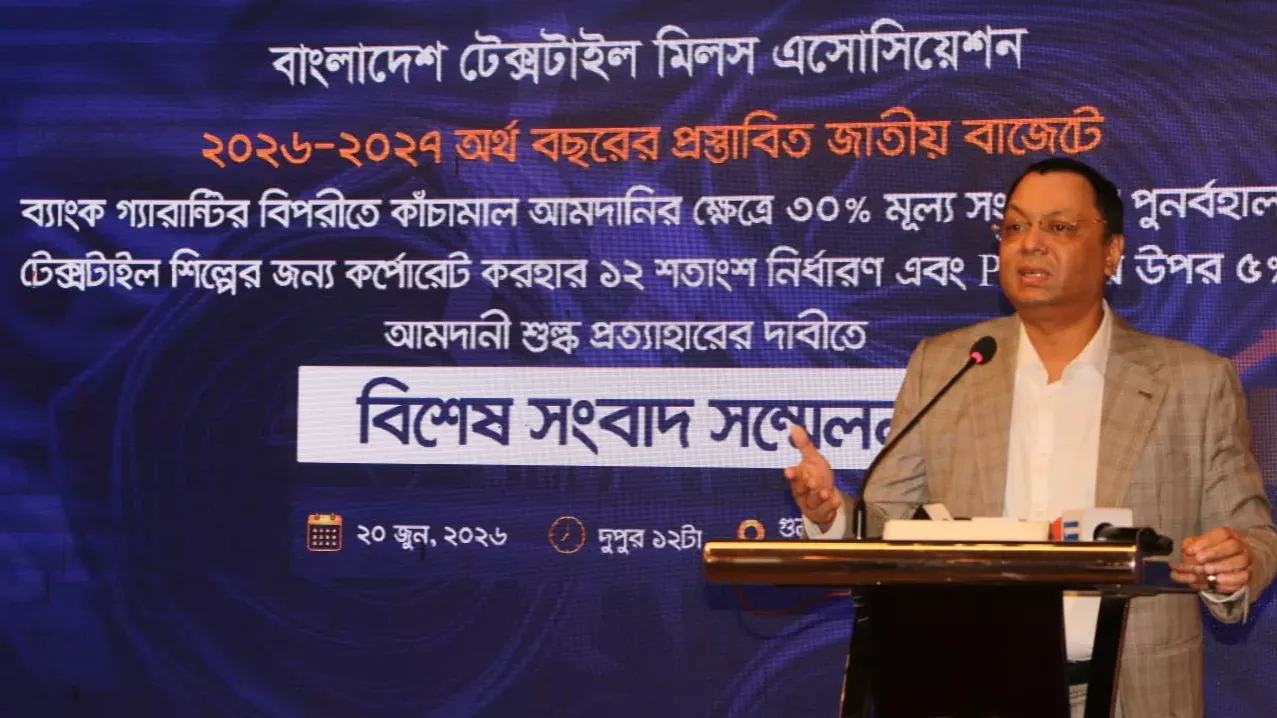
Bangladesh Textile Mills Association (BTMA) on Saturday urged the government to retain the existing condition of 30 percent value addition for importing raw materials against bank guarantees to protect the domestic textile sector.
Expressing deep concern over the proposed national budget for the fiscal year FY2026-27, which seeks to withdraw this requirement, the apex body of primary textile mill ownerst said removing the clause would trigger a massive rise in the abuse of bond facilities and fuel unfair market competition.
The demands were raised at a post-budget press conference organised by the BTMA at the Gulshan Club in the capital on Saturday.
BTMA President Showkat Aziz Russell, former director Rajeev Haider, former vice-president Abdullah Al Mamun, and Bangladesh Garments Accessories & Packaging Manufacturers & Exporters Association (BGAPEA) President Md. Shahriar were present at the briefing.
Withdrawing the 30 percent value addition requirement will push the domestic textile industry toward destruction,the BTMA leaders said.
They said retaining this condition is absolutely vital to safeguarding local industries and preserving export competitiveness in the post-LDC graduation era.
The association placed a four-point charter of demands before the government to help the struggling primary textile sector survive its current multi-dimensional crisis:
These are retaining the 30 percent Value Addition Condition:BTMA underscored that to retain international tariff benefits in the future, the country's local value addition rate must be elevated to 40 to 50 percent or higher.
Therefore, maintaining the 30 percent condition is indispensable to sustaining domestic yarn and fabric manufacturing and curbing irregularities in bonded warehouses, it said.
Terming the existing tax structur:e "extremely discriminatory," the BTMA pointed out that while apparel exporters enjoy a 12 percent corporate tax rate, the effective income tax rate for the primary textile sector stands at a staggering 27.5 percent.
The association demanded that the corporate tax rate for textile manufacturing units be lowered to 12 percent and kept effective until June 2030.
The BTMA urged the government to scrap the proposed 5 percent import duty on polyester staple fiber—the primary raw material used to produce man-made fiber (MMF) yarn and fabrics.
Leaders noted that while man-made fibers account for nearly 70 percent of global apparel demand, Bangladesh’s exports remain heavily reliant on cotton. Imposing this duty would escalate yarn production costs, severely hurting the spinning sector and hindering export diversification.
While welcoming the budget proposal to reduce the source tax on export cash incentives from 10 percent to 5 percent, the BTMA demanded a temporary full exemption (zero percent tax) on source taxes to alleviate the ongoing severe liquidity crunch being faced by exporters.
Addressing the briefing, BTMA President Showkat Aziz Russell criticized the lack of clarity regarding the government’s recently announced Tk 60,000 crore economic stimulus package.
"We have not yet seen any roadmap detailing who will receive this money, why, or how it will be disbursed. We have repeatedly told the government that funding sectors with stagnant or low demand will yield no results and will only lead to a waste of public funds," he said.
Russell revealed that Bangladesh imported yarn worth Tk 26,000 crore in the FY2024-25 alone—a massive demand that could have been entirely met by domestic manufacturers.
He noted that since 2019, at least 234 textile factories have shut down across the country, while many operational mills are currently running at only 60 to 70 percent of their capacity. Given these dire straits, the textile sector has the strongest claim to the stimulus funds, he added.