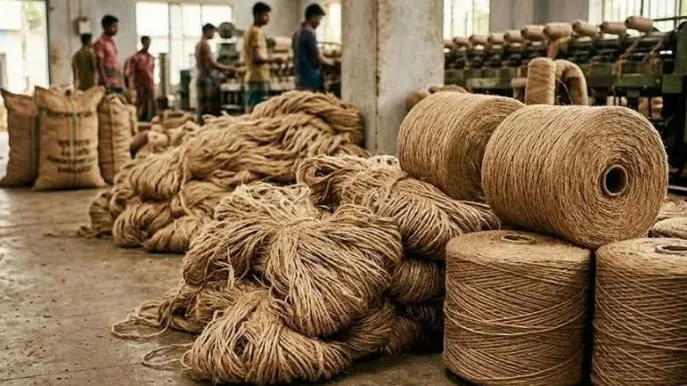
The Indian Ministry of Finance has imposed revised anti-dumping duties of up to $445 per metric tonne on imports of Bangladeshi jute goods—including jute yarn, twine, and sacks—despite an ongoing decline in bilateral shipments over recent years.
The punitive tariffs took effect following a notification issued on September 24, based on recommendations from India's Directorate General of Trade Remedies (DGTR). Following a mid-term review, the DGTR claimed that lower-priced imports from Bangladeshi exporters were undercutting and injuring the domestic Indian jute sector.
Under the new duty structure, 36 identified Bangladeshi jute manufacturing units face duties ranging from a minimum of $59 to $445 per tonne. Any unlisted company exporting jute yarn or twine will attract the ceiling tariff of $445 per tonne, while 17 listed firms face a duty of $120 per tonne on jute sacks. Among the listed entities, Asha Jute Industries Ltd. received the lowest tariff rate at $59 per tonne.
Conversely, six Bangladeshi exporters were granted full duty exemptions across all jute product lines: AM Jute Industries, Bonanza Jute Composite, Lovely Jute Mills, Nawhata Jute Mills, Podder Agro Industries, and Ranu Agro Industries. Additionally, Natore Jute Mills and Janata Jute Mills secured duty-free access specifically for jute sacks and hessian fabric.
The DGTR initiated the probe in June last year following petitions by the Indian Jute Mills Association and the AP Mesta Twine Mills Association, auditing 38 responding mills out of 54 approached across Bangladesh and Nepal. While the DGTR contended that Indian domestic demand contracted by 20 percent whereas imports dropped by only 13 percent, export data demonstrates that Bangladeshi jute shipments to India actually plunged by 18 percent in FY2024–25 to 117,000 tonnes.
Condemning the move, Tapas Pramanik, Chairman of the Bangladesh Jute Spinners Association (BJSA), characterized India's tariff escalation as unilateral and unreasonable. He clarified that the subsidy levels cited by New Delhi do not reflect current realities, as Dhaka currently offers only a modest 3 to 5 percent export cash incentive—significantly lower than historical disbursements. Despite anticipated near-term disruptions in Indian markets, Pramanik expressed optimism that burgeoning global demand for natural and biodegradable fibers will absorb surplus capacities.
According to Export Promotion Bureau (EPB) figures, Bangladesh's national jute export revenues peaked at $1.16 billion in FY2020–21 before dipping to $820 million in FY2024–25, later recovering by 8 percent to $884 million in FY2025–26. Industry insiders warn that the steep duty hike will severely strain the competitiveness of Bangladeshi jute products within India.