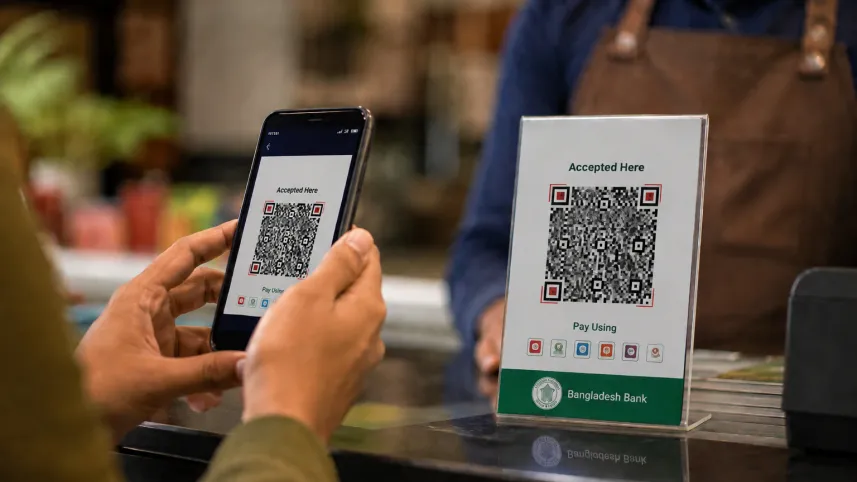
In a decisive structural push to accelerate Bangladesh's transition toward an inclusive, paperless financial ecosystem, landmark regulatory guidelines issued by Bangladesh Bank officially took effect on Thursday (October 1). Under the newly enacted directives from the central bank's Payment Systems Department (PSD), the fee architecture for interoperable 'Bangla QR' payments has been overhauled to make digital collections completely free or negligible for micro-merchants. The regulatory framework slashes Merchant Discount Rates (MDR) and eliminates Interchange Reimbursement Fees (IRF) across small grocery stalls, street vendors, and cottage retailers. The central bank expects the revised framework to encourage widespread adoption among small businesses.
Under the previous fee structure, small merchants were deterred from adopting QR code transactions due to transaction fees eating into their razor-thin profit margins. Central bank officials explained that by eliminating fees for acquiring and issuing banks on small-ticket merchant transactions, financial institutions and mobile financial service (MFS) operators can now onboard micro-retailers without imposing burdensome charges. Additionally, starting today, Bangladesh Bank introduced a cash incentive scheme for Bangla QR payments up to Tk 2,000 processed through the National Payment Switch Bangladesh (NPSB). Acquiring institutions will receive a 0.10 percent incentive, while issuing banks receive 0.20 percent.
The digital roadmap also outlines a major consumer feature scheduled to roll out on November 1, enabling person-to-person (P2P) fund transfers by scanning personal QR codes across different banks and MFS providers. The central bank confirmed that comprehensive automated dispute-resolution mechanisms, notified on September 27, are now fully operational to guarantee instantaneous refunds for failed transactions. Consumers encountering technical glitches can log formal grievances via the dedicated Bangladesh Bank financial helpline at 16236. A high-level executive taskforce chaired by the central bank governor is monitoring field compliance.
Fintech industry leaders and retail trade associations warmly celebrated the policy, predicting that zero-cost QR acceptance will catalyze a massive surge in digital transaction volumes. Chief executive officers of top mobile financial service providers noted that millions of roadside tea stalls, vegetable vendors, and neighborhood pharmacies will now display interoperable QR standees without fear of hidden transaction costs. Bangladesh Dokan Malik Samity leaders remarked that eliminating cash handling risks will safeguard small shopkeepers against petty theft and counterfeit currency. Industry analysts noted that micro-merchants will also build verifiable transaction histories to access formal collateral-free bank loans.
Commercial banks and MFS operators confirmed that technical integrations with the National Payment Switch Bangladesh were completed and tested ahead of today's nationwide enforcement. Participating institutions launched nationwide awareness campaigns across wholesale municipal markets in Dhaka, Chattogram, and Sylhet to train small vendors on verifying digital payment receipts via smartphone audio notifications. The central bank confirmed that periodic field audits will be conducted to ensure that no commercial bank or payment gateway unlawfully levies transaction fees on registered micro-merchants. The zero-fee policy represents a transformative milestone toward building a transparent, cashless economy.